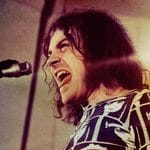
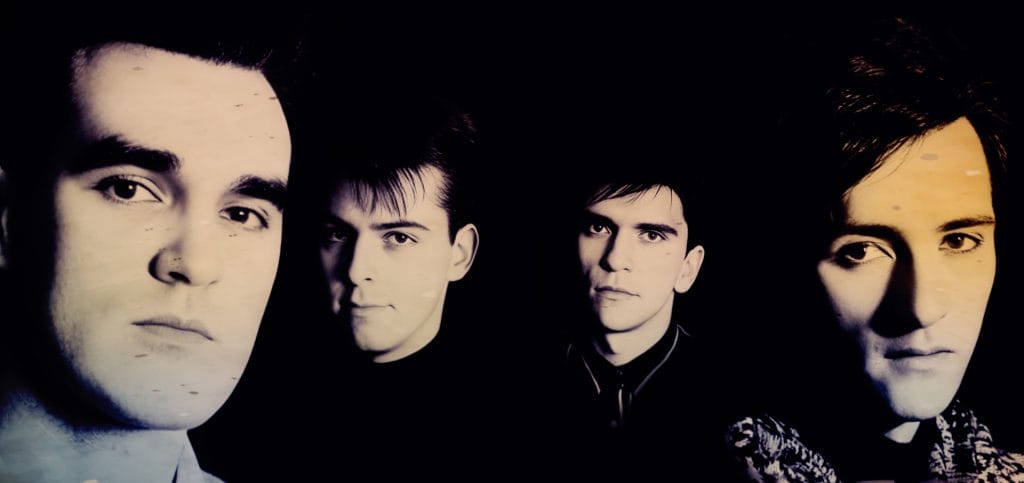
The Smiths in concert from Germany – recorded at Markhalle in Hamburg on May 4, 1984 for West German Radio.
Since we ran a Johnny Marr concert yesterday, which included a few legacy songs from The Smiths period, I thought it might be a good idea to include this concert as a sort of supplement. In the odd event you aren’t familiar, giving you a little historic context is what we’re all about.
The Smiths’s music has been described as indie pop, indie rock, jangle pop, post-punk and alternative rock. According to Steve Jelbert of The Independent, “Whole eras and genres collide in their music: Sixties soul and rock, funk, glam, rockabilly, African high life and plenty of studio electrickery.” Morrissey and Marr dictated the musical direction of the Smiths. Marr said in 1990 that it “was a 50/50 thing between Morrissey and me. We were completely in sync about which way we should go for each record”. The Smiths’ “non-rhythm-and-blues, whiter-than-white fusion of 1960s rock and post-punk was a repudiation of contemporary dance pop”, and the band purposely rejected synthesizers and dance music. From their second album Meat Is Murder, Marr embellished their songs with keyboards.
Marr’s jangly guitar-playing was influenced by James Honeyman-Scott of the Pretenders, and Bert Jansch of Pentangle. Marr often used a capo to tune his guitar up a full step to F-sharp to accommodate Morrissey’s vocal range and also used open tunings. Citing producer Phil Spector as an influence, Marr said, “I like the idea of records, even those with plenty of space, that sound ‘symphonic’. I like the idea of all the players merging into one atmosphere”. Marr’s other favourite guitarists are James Williamson of the Stooges, Rory Gallagher, Pete Townshend of the Who, Jimi Hendrix, Marc Bolan of T. Rex, Keith Richards of the Rolling Stones, and John McGeoch of Magazine and Siouxsie and the Banshees. In a 2007 interview for the BBC, Marr said that his goal was to “pare down” his style and avoid rock guitar clichés. Marr used “arpeggiated chords, open-string licks and unusual progressions” and his style “combined the chime of ’60s jangle-pop bands with the pared-down musicality of players like Nile Rodgers and Keith Richards.” Marr also used an overdrive pedal in “London“. The guitarist has also spoken of his interest in bringing in “little arty things [that] are subversive” to the group, citing these as the “values [he] grew up with” via acts like Roxy Music and naming as examples the samples of a brass band on “Sheila Take a Bow” and the film The L-Shaped Room on “The Queen Is Dead“, respectively, as well as “the musique concrète aspects” and “fade in/fade out” technique in other songs.
Morrissey’s role was to create vocal melodies and lyrics. Morrissey’s songwriting was influenced by punk rock and post-punk bands such as New York Dolls, the Cramps, the Specials and the Cult, along with 1960s girl groups and singers such as Dusty Springfield, Sandie Shaw, Marianne Faithfull and Timi Yuro. Morrissey’s lyrics, while superficially depressing, were often full of mordant humor; John Peel remarked that the Smiths were one of the few bands capable of making him laugh out loud. Influenced by his childhood interest in the social realism of 1960s “kitchen sink” television plays, Morrissey wrote about ordinary people and their experiences with despair, rejection and death. While “songs such as ‘Still Ill’ sealed his role as spokesman for disaffected youth”, Morrissey’s “manic-depressive rants” and his “‘woe-is-me’ posture inspired some hostile critics to dismiss the Smiths as ‘miserabilists.'” Julian Stringer characterized the Smiths as “one of Britain’s most overtly political groups”, while in his study of their work, Andrew Warnes termed them “the most anti-capitalist of bands”.
Press Play and dive in – here comes the weekend.