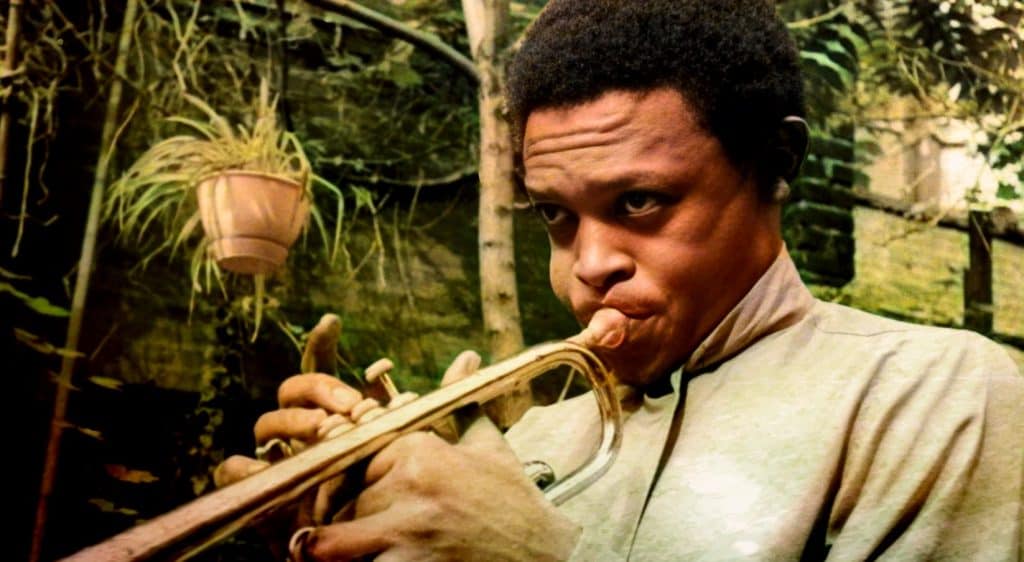
Hugh Masekela – Father of South African Jazz
Hugh Masekela this weekend – recorded in New York, circa 1969 (according to the Hugh Masekela Preservation Project, where this recording comes from).
It was Hugh Masekela who pretty much kicked off the interest in South African Jazz. There were hints of it here and there. Labeled Township Jive in the 1950s, it made its presence known by way of clandestine recordings, made secretly during the Apartheid era and smuggled up to the UK where they got limited distribution, but enough to make an awareness that a new breath of fresh air was coming.
Some artists migrated (those who could afford it) to the UK where careers flourished. Among the most notable was Hugh Masekela.
Here’s an excerpt from his website bio, to give you an idea (if you don’t already know) who Hugh Masekela was and what he was all about:
Hugh Masekela was a world-renowned flugelhornist, trumpeter, bandleader, composer, singer and defiant political voice who remained deeply connected at home, while his international career sparkled. He was born in the town of Witbank, South Africa in 1939. At the age of 14, the deeply respected advocator of equal rights in South Africa, Father Trevor Huddleston, provided Masekela with a trumpet and, soon after, the Huddleston Jazz Band was formed. Masekela began to hone his, now signature, Afro-Jazz sound in the late 1950s during a period of intense creative collaboration, most notably performing in the 1959 musical King Kong, written by Todd Matshikiza, and, soon thereafter, as a member of the now legendary South African group, the Jazz Epistles (featuring the classic line up of Kippie Moeketsi, Abdullah Ibrahim and Jonas Gwangwa).
In 1960, at the age of 21 he left South Africa to begin what would be 30 years in exile from the land of his birth. On arrival in New York he enrolled at the Manhattan School of Music. This coincided with a golden era of jazz music and the young Masekela immersed himself in the New York jazz scene where nightly he watched greats like Miles Davis, John Coltrane, Thelonious Monk, Charlie Mingus and Max Roach. Under the tutelage of Dizzy Gillespie and Louis Armstrong, Hugh was encouraged to develop his own unique style, feeding off African rather than American influences – his debut album, released in 1963, was entitled Trumpet Africaine.
In the late 1960s Hugh moved to Los Angeles in the heat of the ‘Summer of Love’, where he was befriended by hippie icons like David Crosby, Peter Fonda and Dennis Hopper. In 1967 Hugh performed at the Monterey Pop Festival alongside Janis Joplin, Otis Redding, Ravi Shankar, The Who and Jimi Hendrix. In 1968, his instrumental single ‘Grazin’ in the Grass’ went to Number One on the American pop charts and was a worldwide smash, elevating Hugh onto the international stage.
His subsequent solo career has spanned 5 decades, during which time he has released over 40 albums (and been featured on countless more) and has worked with such diverse artists as Harry Belafonte, Dizzy Gillespie, The Byrds, Fela Kuti, Marvin Gaye, Herb Alpert, Paul Simon, Stevie Wonder and the late Miriam Makeba.
In 1990 Hugh returned home, following the unbanning of the ANC and the release of Nelson Mandela – an event anticipated in Hugh’s anti-apartheid anthem ‘Bring Home Nelson Mandela’ (1986) which had been a rallying cry around the world.
Okay – now you know – dive in and let Hugh Masekela do the rest.