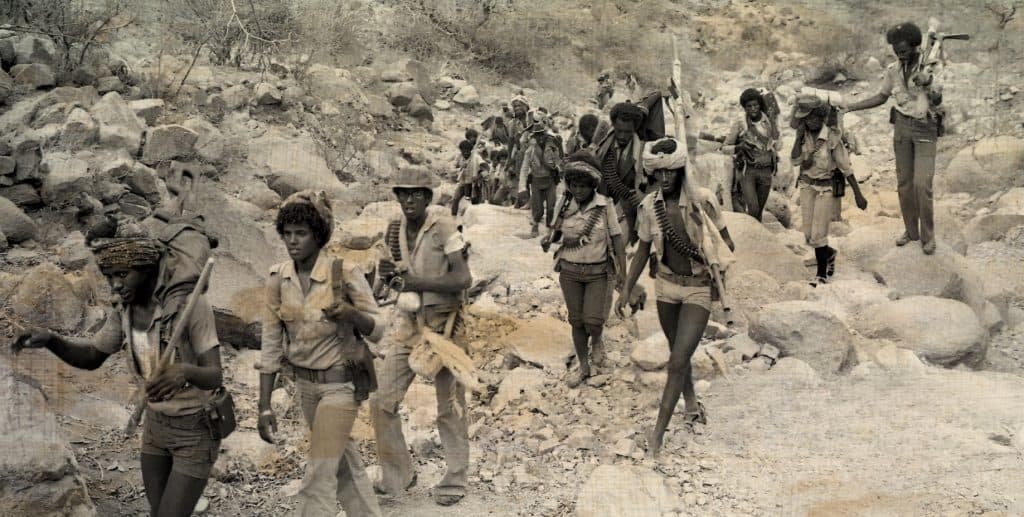
In August of 1997 the BBC World Service, as part of their weekly Assignment series, produced a documentary on the African nation of Eritrea, observing, some six years almost to the day Independence was declared and how the country was evolving in that time.
Going back to the start of the war for Independence in 1977, the documentary focuses on the struggles and the years-long civil war that took place in order to arrive at that place in 1990 where its ties to Ethiopia, who annexed the country in 1962, were severed.
Some background on Eritrea via Wikipedia:
Militant opposition to the incorporation of Eritrea into Ethiopia had begun in 1958 with the founding of the Eritrean Liberation Movement (ELM,Arabic: حركات تحرير إريتريا (Movements for liberation of Eritrea), Tigrinya: ማህበር ሸውዓተ Mahber showate (Association of Seven)), an organization made up mainly of students, intellectuals, and urban wage laborers. The ELM, under the leadership of the Eritrean Hamid Idris Awate, engaged in clandestine political activities intended to cultivate resistance to the centralizing policies of the imperial Ethiopian state. By 1962, however, the ELM had been discovered and destroyed by imperial authorities.
Emperor Haile Selassie unilaterally dissolved the Eritrean parliament and illegally annexed the country in 1962. The war continued after Haile Selassie was ousted in a coup in 1974. The Derg, the new Ethiopian government, was a Marxist military junta led by strongman Mengistu Haile Mariam.
In 1960 Eritrean exiles in Cairo founded the Eritrean Liberation Front (ELF), which led the Eritrean independence struggle during the 1960s. In contrast to the ELM, from the outset the ELF was bent on waging armed struggle on behalf of Eritrean independence. The ELF was composed mainly of Eritrean Muslims from the rural lowlands on the western edge of the territory. In 1961 the ELF’s political character was vague, but radical Arab states such as Syria and Iraq saw Eritrea as a predominantly Muslim region struggling to escape Ethiopian oppression and imperial domination. These two countries therefore supplied military and financial assistance to the ELF.
The ELF initiated military operations in 1961 and intensified its activities in response to the dissolution of the federation in 1962. By 1967 the ELF had gained considerable support among peasants, particularly in Eritrea’s north and west, and around the port city of Massawa. Haile Selassie attempted to calm the growing unrest by visiting Eritrea and assuring its inhabitants that they would be treated as equals under the new arrangements. Although he doled out offices, money, and titles mainly to Christian highlanders in the hope of co-opting would-be Eritrean opponents in early 1967, the imperial secret police of Ethiopia also set up a wide network of informants in Eritrea and conducted disappearances, intimidations and assassinations among the same populace driving several prominent political figures into exile. Imperial police fired live ammunition killing scores of youngsters during several student demonstrations in Asmara in this time. The imperial army also actively perpetrated massacres until the ousting of the Emperor by the Derg in 1974.
By 1971 ELF activity had become enough of a threat that the emperor had declared martial law in Eritrea. He deployed roughly half of the Ethiopian army to contain the struggle. Internal disputes over strategy and tactics eventually led to the ELF’s fragmentation and the founding in 1972 of the Eritrean People’s Liberation Front (EPLF). The leadership of this multi-ethnic movement came to be dominated by leftist, Christian dissidents who spoke Tigrinya, Eritrea’s predominant language. Sporadic armed conflict ensued between the two groups from 1972 to 1974, even as they fought Ethiopian forces. By the late 1970s, the EPLF had become the dominant armed Eritrean group fighting against the Ethiopian Government, and Isaias Afewerki had emerged as its leader. Much of the material used to combat Ethiopia was captured from the army.
By 1977 the EPLF seemed poised to drive the Ethiopians out of Eritrea. However, that same year a massive airlift of Soviet arms to Ethiopia enabled the Ethiopian Army to regain the initiative and forced the EPLF to retreat to the bush. Between 1978 and 1986 the Derg launched eight unsuccessful major offensives against the independence movement. In 1988 the EPLF captured Afabet, headquarters of the Ethiopian Army in northeastern Eritrea, putting approximately a third of the Ethiopian Army out of action and prompting the Ethiopian Army to withdraw from its garrisons in Eritrea’s western lowlands. EPLF fighters then moved into position around Keren, Eritrea’s second-largest city. Meanwhile, other dissident movements were making headway throughout Ethiopia. At the end of the 1980s the Soviet Union informed Mengistu that it would not renew its defense and cooperation agreement. With the withdrawal of Soviet support and supplies, the Ethiopian Army’s morale plummeted, and the EPLF, along with other Ethiopian rebel forces, began to advance on Ethiopian positions. In 1980 the Permanent Peoples’ Tribunal determined that the right of the Eritrean people to self-determination does not represent a form of secession.
In May 1991 the EPLF established the Provisional Government of Eritrea (PGE) to administer Eritrean affairs until a referendum was held on independence and a permanent government established. EPLF leader Afewerki became the head of the PGE, and the EPLF Central Committee served as its legislative body.
Eritreans voted overwhelmingly in favor of independence between 23 and 25 April 1993 in a UN-monitored referendum. The result of the referendum was 99.83% for Eritrea’s independence. The Eritrean authorities declared Eritrea an independent state on 27 April 1993. The government was reorganized and the National Assembly was expanded to include both EPLF and non-EPLF members. The assembly chose Isaias Afewerki as president. The EPLF reorganized itself as a political party, the People’s Front for Democracy and Justice (PFDJ).
In 1998 a border dispute with Ethiopia, over the town of Badme, led to the Eritrean-Ethiopian War in which thousands of soldiers from both countries died. Eritrea suffered from significant economic and social stress, including massive population displacement, reduced economic development, and one of Africa’s most severe land mine problems.
The border war ended in 2000 with the signing of the Algiers Agreement. Amongst the terms of the agreement was the establishment of a UN peacekeeping operation, known as the United Nations Mission in Ethiopia and Eritrea (UNMEE); with over 4,000 UN peacekeepers.
In September 2018, President Isaias Afwerki and Prime Minister of Ethiopia, Abiy Ahmed, signed a historic peace agreement between the two countries.
On 8 July 2017, the entire capital city of Asmara was listed as a UNESCO World Heritage Site, with the inscription taking place during the 41st World Heritage Committee Session.
Since not knowing about history, or the world in general is becoming more critical every day, learning a little bit about what’s going on around you and why and for how long can only be described as a good thing and crucial if we’re going to make educated decisions about anything. Eritrea may not figure prominently in where you live now, but it probably will someday and this documentary will come in very handy.
Here is Assignment from the BBC World Service on August 7, 1997.