For all the bizarre situations in even more bizarre Musicals for the Broadway stage, with the possible exception of Franz Kafka, a musical based on a series of short stories about a love affair between a cat and a cockroach might bend the roles of credulity well past the point of breaking, but Archy and Mehitabel became two of those characters which wound up as legends in American Popular Culture from roughly 1916 to as late as 2018. Maybe not in direct reference, but well imbedded in our national psyche.
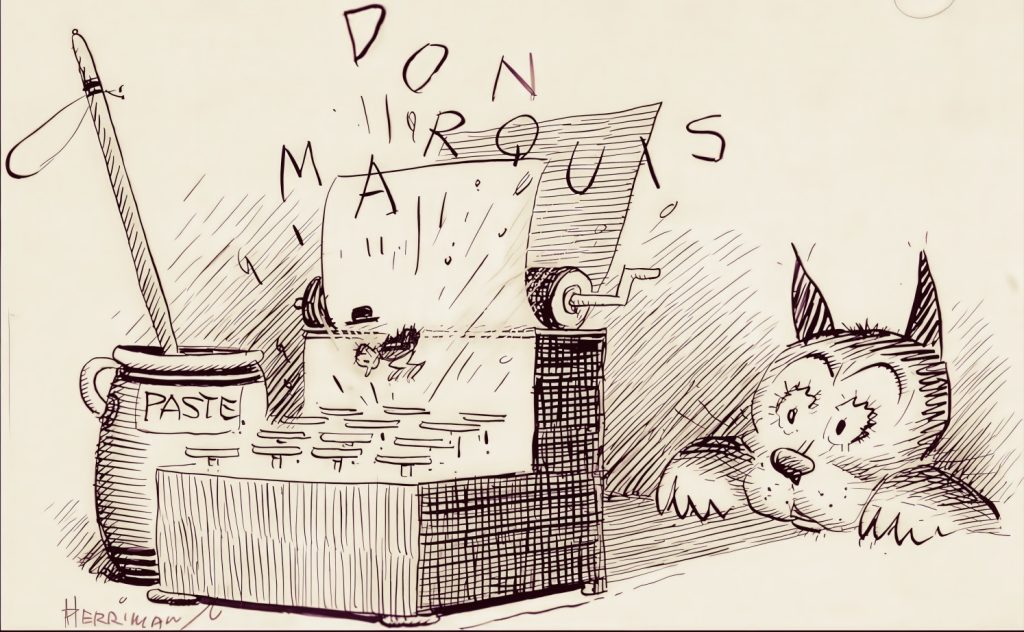
Archy and Mehitable were the creations of Don Marquis, a columnist for The Evening Sun newspaper in New York City. Archy, a cockroach, and Mehitabel, an alley cat, appeared in hundreds of humorous verses and short stories in Marquis’s daily column, “The Sun Dial”. Their exploits were first collected in the 1927 book archy and mehitabel, which remains in print today, and in two later volumes, archys life of mehitabel (1933) and archy does his part (1935). Many editions are recognized by their distinctive illustrations by George Herriman, the creator of Krazy Kat.
Marquis introduced Archy into his daily newspaper column at New York’s Evening Sun. Archy—whose name was always written in lower case in the book titles, but was upper case when Marquis would write about him in narrative form—was a cockroach who had been a free verse poet in a previous life, and took to writing stories and poems on an old typewriter at the newspaper office when everyone in the building had left. Archy would climb up onto the typewriter and jump on one key at a time, laboriously typing out stories of the daily challenges and travails of a cockroach. Archy’s best friend was Mehitabel, an alley cat, who thought of herself as a reincarnated Cleopatra and one of “King Tut-ankh-amen’s favorite queens.” The two of them shared a series of day-to-day adventures that made satiric commentary on daily life in the city during the 1910s and 1920s.
Due to his small size, Archy was unable to operate the shift key on the typewriter and thus wrote his stories entirely in lowercase, with no punctuation. When Marquis wrote in his own persona, though, he always used correct capitalization and punctuation. As E. B. White wrote in his introduction to The Lives and Times of Archy and Mehitabel, it would be incorrect to conclude that, “because Don Marquis’s cockroach was incapable of operating the shift key of a typewriter, nobody else could operate it.”
There was at least one point in which Archy happened to jump onto the shift lock key, a chapter titled “CAPITALS AT LAST”.
Pete the Pup is another of Marquis’ characters. Pete is a Boston Terrier with a passion for life and devotion to his “master”. Like Marquis’ other animal characters, Pete types his poetry at night on the author’s typewriter (seldom capitalizing or using punctuation). Unlike many of the other characters’ contributions, Pete writes about his uncomplicated life without strong political or social references.
A musical version of the Archy and Mehitabel materials was recorded July 7, 1953, and April 9, 1954, entitled archy and mehitabel with Carol Channing as Mehitabel and Eddie Bracken as Archy, and narrated by David Wayne, with Percival Dove as Bill, the fierce tomcat. It was followed by echoes of archy, narrated by David Wayne, recorded August 31, 1954. The credits read: Words—Joe Darion, Music—George Kleinsinger. It was originally released as Columbia Masterworks ML 4963 in 1955, and was re-released on CD, combined with the unrelated work Carnival of the Animals, featuring Noël Coward reading the Ogden Nash poems, as part of the Columbia Masterworks series. The radio broadcast version of the musical debuted on March 5, 1955 and this is the recording we’re running today.
The music and lyrics from the album were the basis of a short-lived 1957 loud and brassy Broadway musical titled Shinbone Alley, starring Eddie Bracken as Archy and Eartha Kitt as Mehitabel. It was based on the columns and on the Columbia Masterworks album, but with additional music by Kleinsinger and dialog by Mel Brooks.
On May 16, 1960, an abridged version of the musical was broadcast under the original title archy & mehitabel as part of the syndicated TV anthology series Play of the Week presented by David Susskind. The cast included Bracken, Tammy Grimes, and Jules Munshin.
Some of the songs from the album were used in 1971 in an animated film, also called Shinbone Alley. Directed by John Wilson, produced by Preston M. Fleet (the creator of Fotomat and Omnimax), and starring Eddie Bracken and Carol Channing. It was not a commercial success.
Actor Jeff Culbert toured a solo show to fringe festivals across North America during 2009 to 2011. The show, archy and mehitabel, was based on Archy’s writings and involved Culbert playing the characters of Archy and Mehitabel.
American actor, singer, and clown Gale McNeeley traveled the United States in 2016 with his Archy and Mehitabel 100th Anniversary Tour. McNeeley’s show featured in the introduction to editor Michael Sim’s The Annotated Archy and Mehitabel by Penguin Classics. Lisa Dunseth, Program Manager of Book Arts & Special Collections at San Francisco’s Main Library said of McNeeley, “His 100th Anniversary Tour is the perfect opportunity to become a fan, if you aren’t already, and enjoy the still-funny and sometimes wicked humor of Don Marquis’s famous cockroach and infamous cat.”
Composer Gabriel Lubell wrote a work for baritone, clarinet, cello, and piano called Archy Speaks (2009). The work sets four of the original poems to music.
Archy and Mehitabel won audiences because it offered something fresh and layered: the conceit of a cockroach poet banging out lowercase free verse on a typewriter was whimsical and instantly memorable, while the pairing with Mehitabel, the free-spirited alley cat who claimed to be the reincarnation of Cleopatra, gave the stories lively, contrasting personalities. Their voices let Don Marquis deliver sharp social satire—on politics, morality crusades, and human folly—wrapped in humor rather than sermonizing, and the mix of wry comedy with poignant undertones made readers feel both entertained and moved. Unlike much highbrow poetry of the time, Archy’s conversational style was accessible in daily newspapers, so the wit reached a wide audience. At the same time, the timing was right: in a rapidly urbanizing, modernizing America, people recognized themselves in the characters’ resilience, gallows humor, and down-to-earth wisdom. This combination of originality, accessibility, satire, pathos, and vivid character interplay is what made Archy and Mehitabel so enduringly popular.
This broadcast, which is the same as the recording released later, features Eddie Bracken and Carol Channing as Archy and Mehitabel with David Wayne as narrator.
Further evidence Pop Culture is wide and unpredictable.
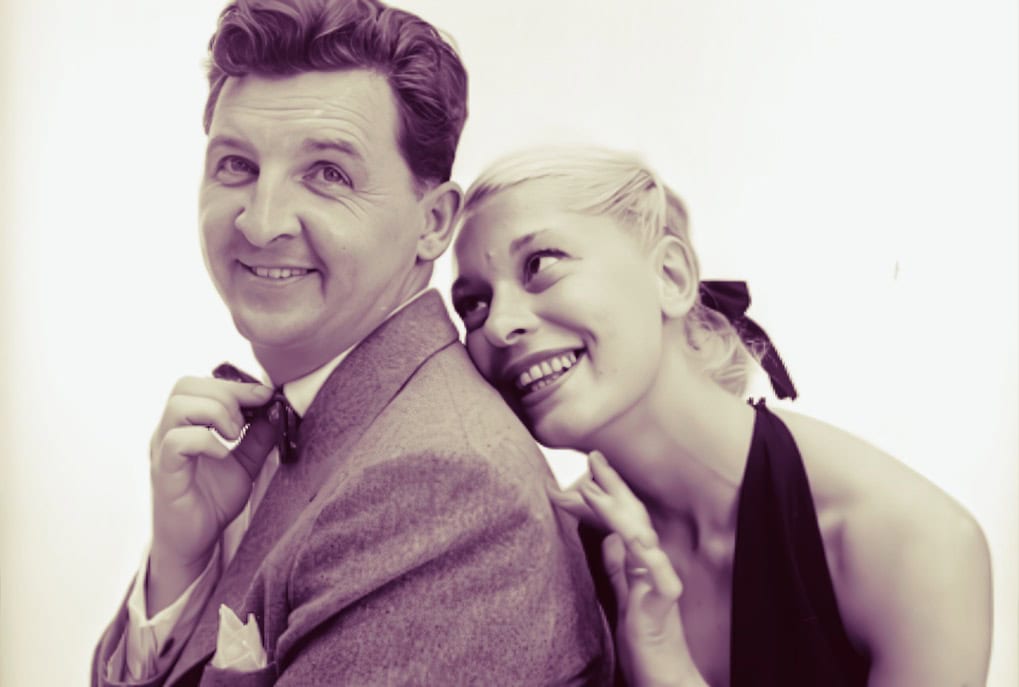
Eddie Bracken (R) as Archy and Carol Channing (L) as Mehitabel from the original production.