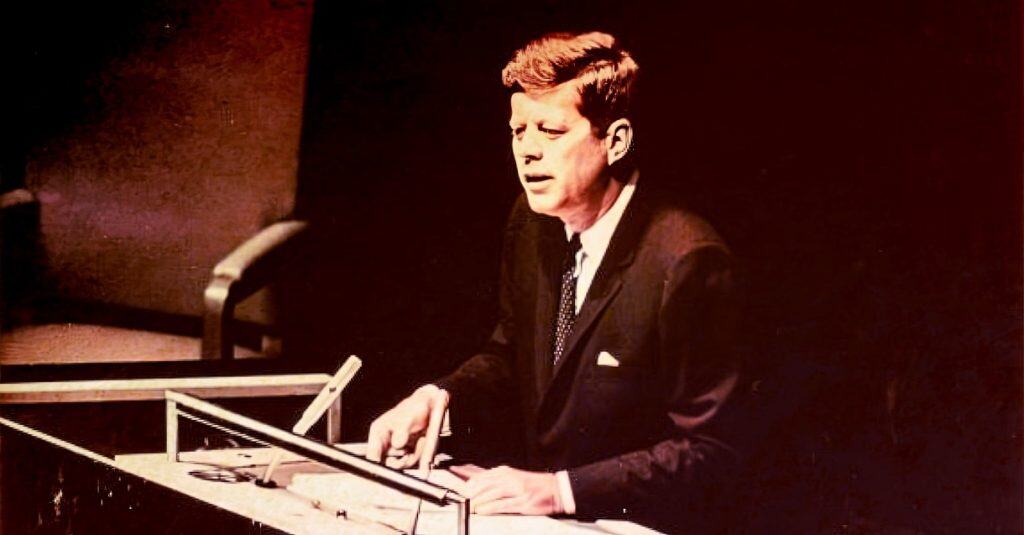
Sixty-four years ago today, President John F. Kennedy addressed the General Assembly of the United Nations:
President Kennedy: We meet in an hour of grief and challenge. Dag Hammarskjold is dead. But the United Nations lives. His tragedy is deep in our hearts, but the task for which he died is at the top of our agenda. A noble servant of peace is gone. But the quest for peace lies before us.
The problem is not the death of one man–the problem is the life of this organization. It will either grow to meet the challenges of our age, or it will be gone with the wind, without influence, without force, without respect. Were we to let it die, to enfeeble its vigor, to cripple its powers, we would condemn our future.
For in the development of this organization rests the only true alternative to war–and war appeals no longer as a rational alternative. Unconditional war can no longer lead to unconditional victory. It can no longer serve to settle disputes. It can no longer concern the great powers alone. For a nuclear disaster, spread by wind and water and fear, could well engulf the great and the small, the rich and the poor, the committed and the uncommitted alike. Mankind must put an end to war–or war will put an end to mankind.
So let us here resolve that Dag Hammarskjold did not live, or die, in vain. Let us call a truce to terror. Let us invoke the blessings of peace. And as we build an international capacity to keep peace, let us join in dismantling the national capacity to wage war.
This will require new strength and new roles for the United Nations. For disarmament without checks is but a shadow–and a community without law is but a shell. Already the United Nations has become both the measure and the vehicle of man’s most generous impulses. Already it has provided–in the Middle East, in Asia, in Africa this year in the Congo–a means of holding man’s violence within bounds.
But the great question which confronted this body in 1945 is still before us: whether man’s cherished hopes for progress and peace are to be destroyed by terror and disruption, whether the “foul winds of war” can be tamed in time to free the cooling winds of reason, and whether the pledges of our Charter are to be fulfilled or defied–pledges to secure peace, progress, human rights and world law
In this Hall, there are not three forces, but two. One is composed of those who are trying to build the kind of world described in Articles I and II of the Charter. The other, seeking a far different world, would undermine this organization in the process.
Today, of all days our dedication to the Charter must be maintained. It must be strengthened first of all by the selection of an outstanding civil servant to carry forward the responsibilities of the Secretary General–a man endowed with both the wisdom and the power to make meaningful the moral force of the world community. The late Secretary General nurtured and sharpened the United Nations’ obligation to act. But he did not invent it. It was there in the Charter. It is still there in the Charter.
However difficult it may be to fill Mr. Hammarskjold’s place, it can better be filled by one man rather than three. Even the three horses of the Troika did not have three drivers, all going in different directions. They had only one–and so must the United Nations executive. To install a triumvirate, or any panel, or any rotating authority, in the United Nations administrative offices would replace order with anarchy, action with paralysis, confidence with confusion.
The Secretary General, in a very real sense, is the servant of the General Assembly. Diminish his authority and you diminish the authority of the only body where all nations, regardless of power, are equal and sovereign. Until all the powerful are just, the weak will be secure only in the strength of this Assembly.
Effective and independent executive action is not the same question as balanced representation. In view of the enormous change in membership in this body since its founding, the American delegation will join in any effort for the prompt review and revision of the composition of United Nations bodies.
But to give this organization three drivers–to permit each great power to decide its own case, would entrench the Cold War in the headquarters of peace. Whatever advantages such a plan may hold out to my own country, as one of the great powers, we reject it. For we far prefer world law, in the age of self-determination, to world war, in the age of mass extermination.
Today, every inhabitant of this planet must contemplate the day when this planet may no longer be habitable. Every man, woman and child lives under a nuclear sword of Damocles, hanging by the slenderest of threads, capable of being cut at any moment by accident or miscalculation or by madness. The weapons of war must be abolished before they abolish us.
Men no longer debate whether armaments are a symptom or a cause of tension. The mere existence of modern weapons–ten million times more powerful than any that the world has ever seen, and only minutes away from any target on earth–is a source of horror, and discord and distrust. Men no longer maintain that disarmament must await the settlement of all disputes–for disarmament must be a part of any permanent settlement. And men may no longer pretend that the quest for disarmament is a sign of weakness–for in a spiraling arms race, a nation’s security may well be shrinking even as its arms increase.
For fifteen years this organization has sought the reduction and destruction of arms. Now that goal is no longer a dream–it is a practical matter of life or death. The risks inherent in disarmament pale in comparison to the risks inherent in an unlimited arms race.
It is in this spirit that the recent Belgrade Conference–recognizing that this is no longer a Soviet problem or an American problem, but a human problem–endorsed a program of “general, complete and strictly an internationally controlled disarmament.” It is in this same spirit that we in the United States have labored this year, with a new urgency, and with a new, now statutory agency fully endorsed by the Congress, to find an approach to disarmament which would be so far-reaching, yet realistic, so mutually balanced and beneficial, that it could be accepted by every nation. And it is in this spirit that we have presented with the agreement of the Soviet Union–under the label both nations now accept of “general and complete disarmament”–a new statement of newly-agreed principles for negotiation.
But we are well aware that all issues of principle are not settled, and that principles alone are not enough. It is therefore our intention to challenge the Soviet Union, not to an arms race, but to a peace race- -to advance together step by step, stage by stage, until general and complete disarmament has been achieved. We invite them now to go beyond agreement in principle to reach agreement on actual plans.
The program to be presented to this assembly–for general and complete disarmament under effective international control–moves to bridge the gap between those who insist on a gradual approach and those who talk only of the final and total achievement. It would create machinery to keep the peace as it destroys the machinery of war. It would proceed through balanced and safeguarded stages designed to give no state a military advantage over another. It would place the final responsibility for verification and control where it belongs, not with the big powers alone, not with one’s adversary or one’s self, but in an international organization within the framework of the United Nations. It would assure that indispensable condition of disarmament–true inspection–and apply it in stages proportionate to the stage of disarmament. It would cover delivery systems as well as weapons. It would ultimately halt their production as well as their testing, their transfer as well as their possession. It would achieve under the eyes of an international disarmament organization, a steady reduction in force, both nuclear and conventional, until it has abolished all armies and all weapons except those needed for internal order and a new United Nations Peace Force. And it starts that process now, today, even as the talks begin.
In short, general and complete disarmament must no longer be a slogan, used to resist the first steps. It is no longer to be a goal without means of achieving it, without means of verifying its progress, without means of keeping the peace. It is now a realistic plan, and a test–a test of those only willing to talk and a test of those willing to act.
Such a plan would not bring a world free from conflict and greed– but it would bring a world free from the terrors of mass destruction. It would not usher in the era of the super state–but it would usher in an era in which no state could annihilate or be annihilated by another.
In 1945, this Nation proposed the Baruch Plan to internationalize the atom before other nations even possessed the bomb or demilitarized their troops. We proposed with our allies the Disarmament plan of 1951 while still at war in Korea. And we make our proposals today, while building up our defenses over Berlin, not because we are inconsistent or insincere or intimidated, but because we know the rights of free men will prevail–because while we are compelled against our will to rearm, we look confidently beyond Berlin to the kind of disarmed world we all prefer.
I therefore propose on the basis of this Plan, that disarmament negotiations resume promptly, and continue without interruption until an entire program for general and complete disarmament has not only been agreed but has actually been achieved.
Here is the complete address to the United Nations General Assembly, as it was given on September 25, 1961.