
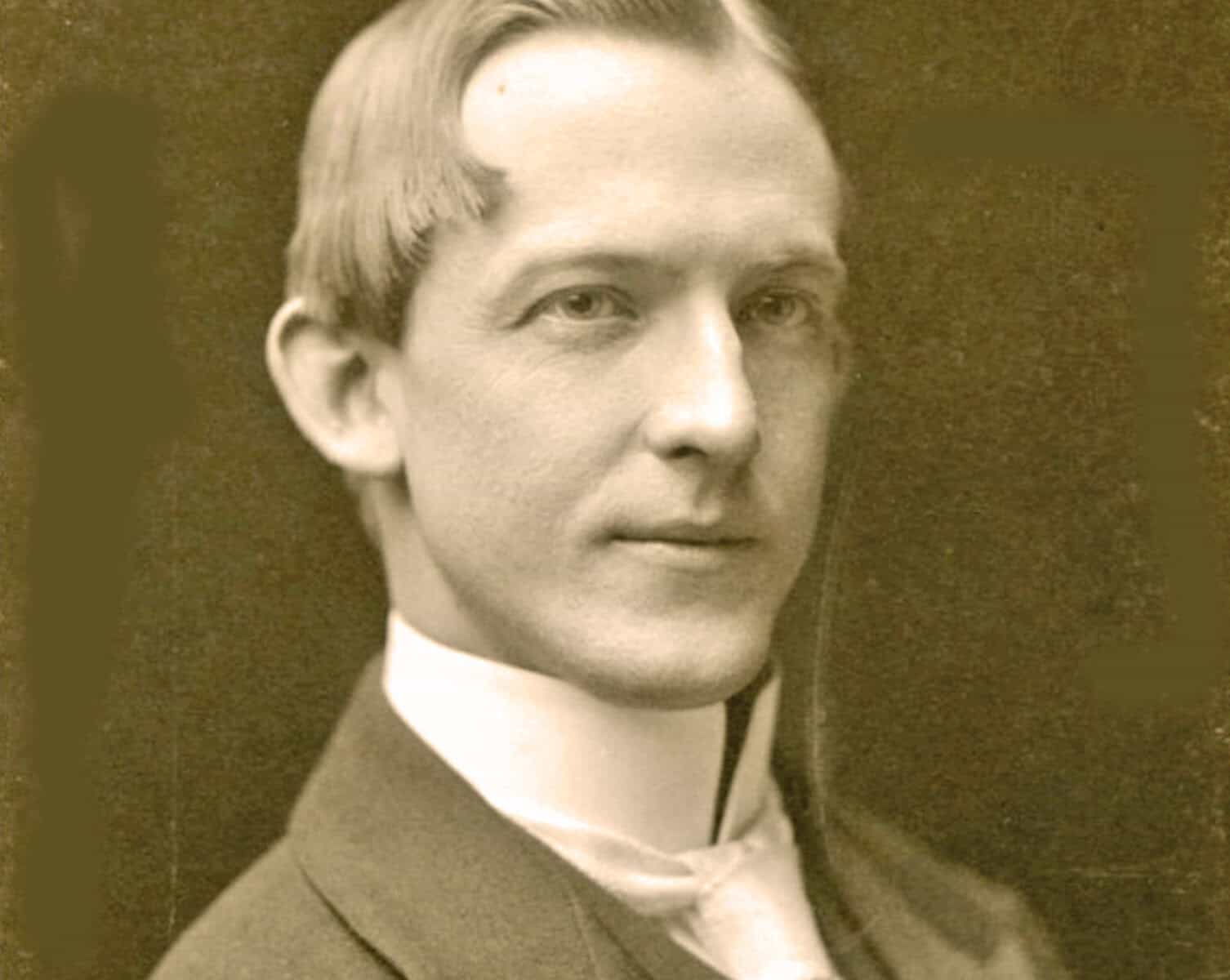
– Henry Hadley Trio – Festival Of American Music – WNYC – February 20, 1941 – Gordon Skene Sound Collection –
The Henry Hadley Trio this weekend, giving the last concert of the 1941 Festival of American Music broadcast over WNYC in New York on February 20, 1941.
The Trio, which consists of Robert Rudier, violin – Sidney Edwards, cello and Ralph Angel, piano was named after the American composer Henry Hadley who had done much to promote and champion American composers.
The program opens with a work by Henry Hadley – the final movement of his Trio for violin, cello and Piano opus 132. It’s followed by the first movement of the 2nd Trio by Harold Morris. After that, it’s A Cambodian Dance by Lily Strickland, followed by the second movement of a new trio by Mortimer Browning and concluding with A Processional by Elliot Griffes.
Henry Hadley, which was heavily influenced by that of Richard Wagner, is Romantic in style, with some Impressionistic touches. After the mid-20th century it was seldom performed. His works include the operas Azora, the Daughter of Montezuma (1917), Bianca (1918), and Cleopatra’s Night (1920); five symphonies; symphonic poems and suites; chamber music; choral works; and songs.
Harold Morris toured extensively as a recitalist and soloist and his compositions were performed frequently during his lifetime. He made his New York concert debut in recital in January 1921 at Aeolian Hall, with a program of Brahms, Busoni, Chopin, Godowsky, Cyril Scott and Charles T. Griffes. On November 21, 1931, Morris was the piano soloist for a performance of his Piano Concerto with the Boston Symphony Orchestra at Carnegie Hall. Morris’ composition, Poem was performed by violinist and conductor Eugène Ysaÿe in Cincinnati, Ohio with the Cincinnati Orchestra on November 29, 1918. Violinist Josef Stransky performed the work at Carnegie Hall with the Philadelphia Orchestra three months later.
Lily Strickland composed works that were used in the silent cinema, art song, and solo piano works. As an early ethnomusicologist, she chronicled her experiences with several musical cultures as a special correspondent for The Music Courier. Her articles include those on Ceylon (The Musical Courier, vol 86, no. 9); music at Hindu Temples (vol. 86 no. 13); “Natuch” dancing (vol. 87, no. 15); snake charmers and music (vol. 87, no. 19); “devil dancing” (vol. 87, no. 20); Tibetan Buddhist music (vol. 87, no. 21); and music related to Krishna (vol. 87, no. 22). She also published several similar articles in The Etude, and was featured by the magazines in several articles about her own compositions.
Born in Boston, Elliot Griffes, son of the noted Orientalist William Elliot Griffis, attended public schools in Ithaca, New York, as well as The Manlius School before going to Ithaca College. He went to Yale University to work with Horatio Parker from 1913 until 1915, and studied at the New England Conservatory of Music with Daniel Gregory Mason, Harry Newton Redman, and George Whitefield Chadwick before serving in the United States Army. He taught at Grinnell College, the Westchester Conservatory of Music and the St. Louis Conservatory of Music before settling in Los Angeles. Much of his output was chamber music, especially piano pieces and songs; he did, however, compose some works for orchestra and one opera, 1963’s The Port of Pleasure. He died in 1967 and is buried at Vale Cemetery in Schenectady, New York.
Enjoy the concert.
And while you’re here . . .you know we don’t run ads – stopped running them more than a few years ago. The ads were noisy and pretty awful and they were a huge distraction, having to wade through a lot of useless barking in order to get to the good stuff. But we still have to pay the bills, and there’s a ton of them and they don’t like to wait. And so we ask you consider becoming a subscriber and support all the stuff we do every day by kicking in what amounts to being an Americano Grande every month to be part of the solution and not the problem. In todays bizarre economy it ain’t much – but it means a ton to Past Daily. All you have to do (and we make this as simple and pain-free as possible) is head over to Patreon (that red box just below that says “Become A Patron” that you click on) and check us out. You can do 7 days free just to kick the tires and take a test drive. And if you like us, hit the subscribe button and become part of our rather haywire little family. Not bad, considering we just want you to like us.


