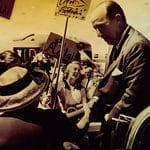
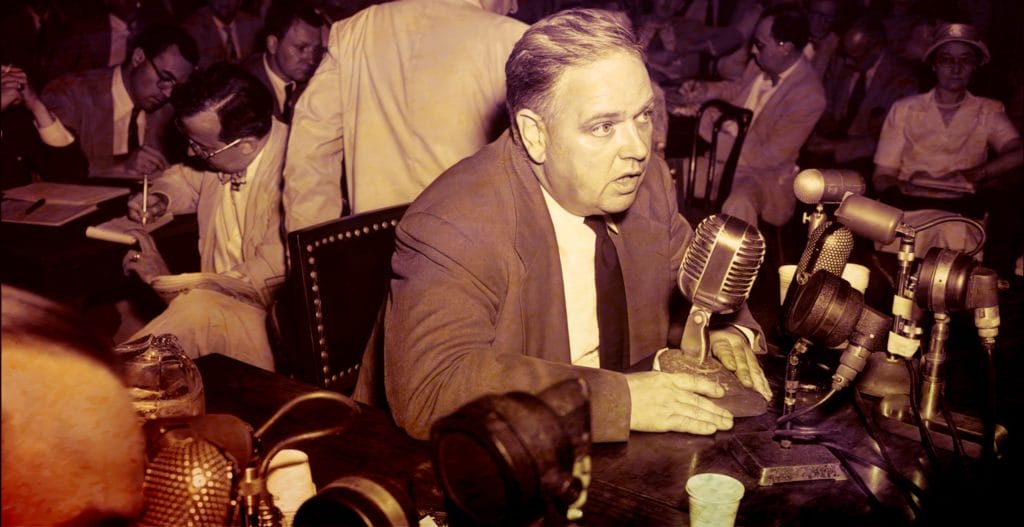
Whittaker Chambers Testifying before House Un-American Activities Hearings – Among other things, gave the world “The Pumpkin Papers”.
With hearings becoming an almost daily spectacle, with no doubt no stopping anytime soon, it’s good to know neither America nor Capitol Hill find the goings on unusual. Disturbing; yes, but unusual; no.
Case in point, the infamous House Un-American Activities investigations in the late 1940s.
The House Un-American Activities Committee hearings of 1948 marked one of the most dramatic and controversial episodes of early Cold War America. Against a backdrop of growing fear over Soviet espionage, political subversion, and ideological conflict, the hearings became a national spectacle that blurred the lines between legitimate security concerns and political theater. By the time Northwestern Reviewing Stand devoted a January 1949 broadcast to the controversy, Americans were deeply divided over whether the investigations protected democracy or endangered it.
At the center of the storm stood Whittaker Chambers, a former Communist Party member and editor at Time magazine, whose testimony before the House Un-American Activities Committee (HUAC) electrified the nation. Chambers accused several former government officials of participating in Communist underground networks during the New Deal era. Most notably, he identified Alger Hiss, a respected State Department official and former adviser at the Yalta Conference, as a Communist operative. Hiss vehemently denied the accusations, setting off one of the most sensational political battles of the twentieth century.
The hearings reflected the growing tension between Congress and the Justice Department over how Communist infiltration should be handled. Many members of HUAC believed the Truman administration and the Department of Justice were moving too cautiously in confronting subversive activity. Committee members often accused federal agencies of weakness, secrecy, or even deliberate obstruction. Meanwhile, officials within the Justice Department worried that HUAC’s aggressive tactics risked damaging constitutional protections and undermining legitimate criminal investigations. The committee sought publicity and broad public exposure, while prosecutors preferred careful evidence gathering and courtroom procedure. This friction became one of the defining features of the 1948 investigations.
Nothing illustrated the dramatic character of the hearings more vividly than the so-called “Pumpkin Papers” episode. After initially failing to convince many Americans of the seriousness of his allegations, Chambers produced rolls of microfilm that he claimed had been hidden on his Maryland farm. According to Chambers, the documents contained copies of classified government material supplied years earlier by Communist sources. He famously concealed portions of the microfilm inside a hollowed-out pumpkin on his property, creating one of the most enduring images of the early Cold War. Newspapers seized upon the bizarre discovery, and the “Pumpkin Papers” became symbolic both of alleged Communist espionage and of the increasingly theatrical nature of anti-Communist investigations.
For critics of HUAC, including many civil libertarians, the hearings represented a dangerous expansion of Congressional power. Edgar Bernhard, chairman of the Chicago chapter of the American Civil Liberties Union and a participant in the Northwestern Reviewing Stand discussion, reflected widespread concern that fear of Communism was eroding fundamental constitutional rights. Critics argued that witnesses were often tried in the court of public opinion rather than in a courtroom. Suspicion alone could destroy reputations, careers, and personal lives. Many feared that the committee’s methods encouraged guilt by association and weakened protections guaranteed by the Bill of Rights.
Supporters of the investigations, however, insisted that the Communist threat was genuine and could not be ignored. Robert F. Hurleigh of the Mutual Broadcasting System represented a viewpoint common among anti-Communist commentators of the period. To many Americans in 1948 and 1949, revelations about Soviet expansion in Eastern Europe, the Berlin Crisis, and reports of espionage justified aggressive investigation. The discovery of atomic spying in later years would reinforce the belief that some of HUAC’s concerns had been legitimate, even if its methods remained controversial.
The debate heard on Northwestern Reviewing Stand captured a nation struggling to balance security and liberty during the uncertain opening years of the Cold War. The hearings exposed deep anxieties about loyalty, patriotism, and dissent in democratic society. They also demonstrated how radio and the emerging national media transformed Congressional investigations into public drama followed by millions of Americans.
In retrospect, the HUAC hearings of 1948 stand as both a warning and a reflection of their era. They revealed that Communist espionage was not entirely imaginary, yet they also showed how fear could encourage excess and political opportunism. The friction between Congress and the Justice Department, the sensationalism of the Pumpkin Papers, and the clash between Whittaker Chambers and Alger Hiss all became defining moments in the history of Cold War America. By early 1949, Americans listening to broadcasts such as Northwestern Reviewing Stand were confronting a difficult question that would shape the coming decade: how could a democracy defend itself against hidden enemies without compromising the freedoms it claimed to protect?
To give you some idea of the contentious nature of this era, here is an episode of Mutual’s Northwestern Reviewing Stand from around January 9, 1949, from a badly damaged set of transcription discs. Garbled in places but nonetheless a historic glimpse into a period of time many would like to forget.