
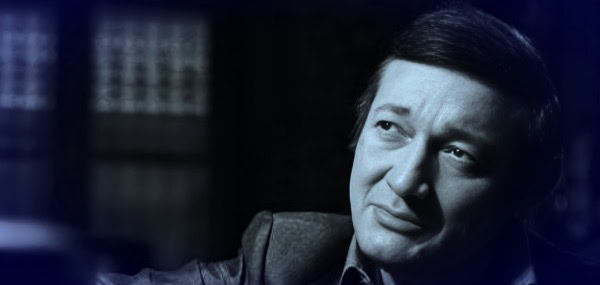
The legendary French-Hungarian Pianist Georges Cziffra with Orchestre National de la Radioffusion Francaise led by Roberto Benzi in a performance of Totentanz, paraphrase on Dies Irae by Franz Liszt, recorded live at Montreux, Switzerland on September 20, 1962 by ORTF in Paris.
Georges Cziffra was born to a poor Romani family of musicians in Budapest in 1921. In his memoirs, Cziffra describes his father, a player of the cimbalom, as “a cabaret artist”. His parents had lived in Paris before World War I, when they were expelled as enemy aliens.
His earliest exposure to the piano came from watching his elder sister Yolande practice. She had decided she was going to learn the piano after finding a job which allowed her to save the required amount of money for buying an upright piano. Cziffra, who was weak as a child, often watched his sister practice, and mimicked her. He learned without sheet music, instead repeating and improvising over tunes sung by his parents. Later he earned money as a child improvising on popular music at a local circus.
In 1930 Cziffra began to study at the Franz Liszt Academy under the tuition of Ernő Dohnányi until 1941, when he was conscripted into the Hungarian Army. He gave numerous concerts in Hungary, Scandinavia and the Netherlands.
Hungary was allied with the Axis during the Second World War. Cziffra had just married his wife Soleilka, who was pregnant when he entered military training. His unit was sent to the Russian front; however he was captured by Russian partisans and held as a prisoner of war. After the war, he earned a living playing in Budapest bars and clubs, touring with a European jazz band from 1947 to 1950 and earning recognition as a superb jazz pianist and virtuoso.
After attempting to escape Hungary in 1950, Cziffra was again imprisoned and subject to hard labour in the period 1950–1953. In 1956, he successfully escaped with his wife and son to Vienna, where he was warmly received. His successful Paris debut the following year preceded his London debut at the Royal Festival Hall playing Liszt’s first piano concerto and Hungarian Fantasy which was also well received. His career continued with concerts throughout Europe and debuts at the Ravinia Festival (Grieg and Liszt concertos with Carl Schuricht) and Carnegie Hall, New York with Thomas Schippers.
In 1968 he took French citizenship and adapted his hitherto-Hungarian forenames to the French language. In 1977 he founded the Cziffra Foundation, situated in the Saint Frambourg chapel in Senlis, Oise. Cziffra bought and restored the building, with the aim of helping young musicians at the outset of their careers.
Cziffra’s son, György Cziffra Jr., was a professional conductor and participated in several concerts and recordings with his father. However, his promising career was cut short by his death in an apartment fire in 1981. Cziffra never again performed or recorded with an orchestra, and some critics have commented that the severe emotional blow affected his playing quality.
Cziffra died in Longpont-sur-Orge, Essonne, France, aged 72, from a heart attack resulting from a series of complications from lung cancer. He is buried next to his son.
Enjoy the concert snippet.