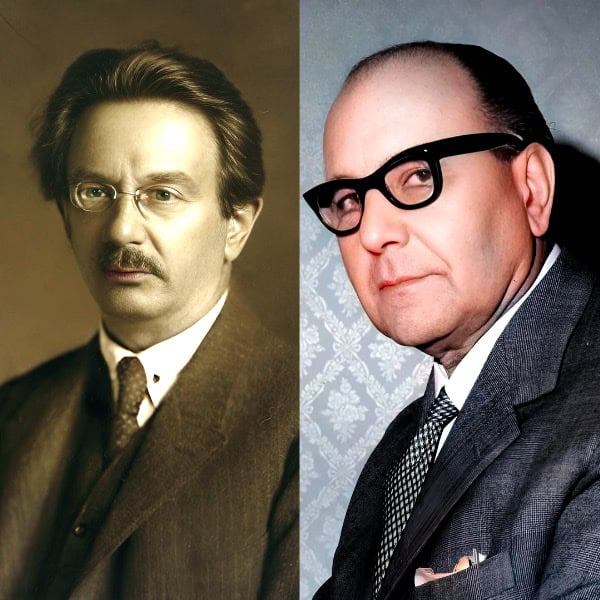
More history this weekend. The Cologne Radio Symphony, conducted by Hans Swarowsky in a performance of Symphony Number 4 by Franz Schmidt – in this radio studio concert from 1964.
Schmidt was born in Pozsony/Pressburg, in the Hungarian part of Austria-Hungary (today Bratislava, Slovakia) to a half-Hungarian father – with the same name, born in the same city – and to a Hungarian mother, Mária Ravasz. He was a Roman Catholic.
His earliest teacher was his mother, Mária Ravasz, an accomplished pianist, who gave him a systematic instruction in the keyboard works of J. S. Bach. He received a foundation in theory from Felizian Josef Moczik [de], the organist at the Franciscan church in Pressburg. He studied piano briefly with Theodor Leschetizky, with whom he clashed. He moved to Vienna with his family in 1888, and studied at the Vienna Conservatory (composition with Robert Fuchs, cello with Ferdinand Hellmesberger, and, for a few lessons, counterpoint with Anton Bruckner, who was already seriously ill at that time), graduating “with excellence” in 1896.
He obtained a post as cellist with the Vienna Court Opera Orchestra, where he played until 1914, often under Gustav Mahler. Mahler habitually had Schmidt play all the cello solos, even though Friedrich Buxbaum was the principal cellist. Schmidt was also in demand as a chamber musician. Schmidt and Arnold Schoenberg maintained cordial relations despite their vast differences in eventual outlook and style (Schmidt certainly shows a perceptible influence from Schoenberg’s early, tonal works such as Verklärte Nacht, Op. 4, in whose Viennese première he participated as cellist, the Chamber Symphony No. 1, Op. 9 and the gigantic cantata Gurre-Lieder. Unable to procure a teaching position for Schoenberg at the Academy, Schmidt rehearsed his students in a performance of Pierrot Lunaire, Op. 21 which Schoenberg warmly praised). Also a brilliant pianist, in 1914 Schmidt took up a professorship in piano at the Vienna Conservatory, which had been recently renamed Imperial Academy of Music and the Performing Arts. (Apparently, when asked who the greatest living pianist was, Leopold Godowsky replied, “The other one is Franz Schmidt.”) In 1925 he became Director of the Academy, and from 1927 to 1931 its Rector.
Schmidt died on 11 February 1939.
Hans Swarowsky (September 16, 1899 – September 10, 1975) was an Austrian conductor of Hungarian birth. Swarowsky was born in Budapest, Hungary. He studied the art of conducting under Felix Weingartner and Richard Strauss. His teachers in musical theory included Arnold Schoenberg and Anton Webern. Herbert von Karajan invited him to take on the permanent position as conductor of the Vienna State Opera. He died in Salzburg, Austria, less than a week before his 76th birthday.
On to the Symphony.