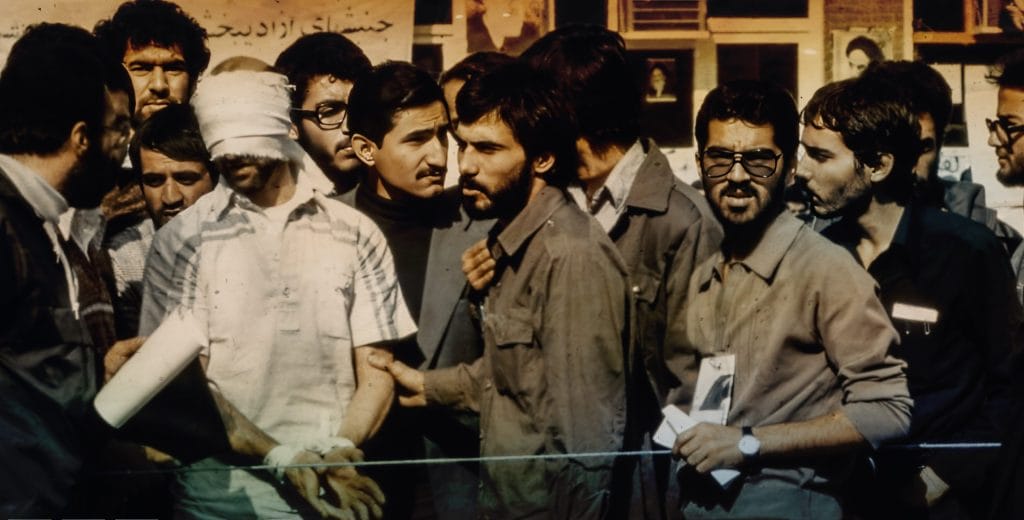
American Hostages In Tehran – Not good for a President’s popularity.
April 14, 1980 and the day’s news was all about the hostages.
Two International Red Cross officials entered d the occupied U.S. Embassy today to visit the American hostages and check on their health. Harald Schmid de Gruneck, permanent representative the International Committee of the Red Cross, walked inside the compound, accompanied by Dr. Bernard Liebeskind, a physician after 1 p.m. (4:30 a.m.
EST) and were still inside at 3.30 p.m. (7 a.m. EST), a spokesman for the Moslem militants holding the hostages told UPI. The spokesman* confirmed that the Swiss members of the Red Cross were meeting the hostages but, he could not say when they would leave the compound. The two-man Red Cross team was accompanied Iranian Health Minister Mousa Zargar, by, Tehran’s religious leader Hojjatoleslam Mohammad Ali Khamenei and Iranian Red Lion and Sun (Red Cross) official Mansour Shamsa.
The Red Cross mission followed meetings last week between President Abolhassan BaniSadr and Foreign Minister Sadegh Ghotbzadeh and envoys of the European Common Market countries and Japan.
And by 65-24 percent, a sizable majority of Americans feel that President Carter’s handling of the hostage situation in Iran has been a failure. This latest ABC News-Harris Survey, taken just after the president broke off all relations with Iran and announced an end of trade with that country, indicates that public criticism has risen sharply during the past few weeks. At the end of March, a 50-30 percent plurality labeled Mr. Carter’s approach in Iran a failure. In January, when Americans were still rallying behind Carter in a wave of patriotism, a 51-32 percent majority thought his patient, low approach was a success.
This confidence began to slip in mid February, when a narrower 44-36 percent plurality tabbed his policy a success. Then it began to turn sour in early March, when a 49-33 percent plurality thought Carter’s handling of the hostage situation was a failure. When asked to rate the way Carter has handled the situation in Iran, a 65-33 percent majority gives him negative marks, according to an April 8 ABC News-Harris Survey of 901 adults nationwide. Before his recent change of policy, a 65- 32 percent majority give him a negative rating on Iran. These low estimates stand in sharp contrast with the situation in mid-December, when a 66-32 percent majority gave the president a positive rating on his approach to Iran. These favorable marks continued until early February, when only a narrow 50-46 percent plurality praised the job he was doing.
And for the first time in history, the United States will not be sending : a team to the Olympic Games. Ralph Mann, a silver medalist in the hurdles in the 1972 Olympics, choked up while discussing the decision and had to walk away from a group of newsmen. Although almost everyone anticipated a pro-boycott vote, there was nothing cut-and-dried about it.
The decision wasn’t an easy one to make, as evidenced by the emotion displayed following Saturday’s historic vote by the USOC’s House of Delegates. Yielding to pressure from the Carter administration, the delegates voted by a 2-to-1 margin to boycott the 1980 Summer Games in Moscow as a protest against the Soviet Union’s military intervention in Afghanistan. If enough other nations join the boycott, the International Olympic Committee might cancel the Games, a senior Olympic official said. Douglas F. Roby, one of two Americans on the IOC, told the Associated Press that if the Carter administration is able to get the Western bloc of nations to join the U.S. boycott, the IOC would not stage the Games, which are scheduled to begin July 19.
“If they get the important ones (nations), it is my opinion the IOC will cancel the Games,” Roby said, mentioning Great Britain, France, West Germany, Australia, New Zealand and Canada. “‘The IOC doesn’t want to see any halfbaked Games.
Finally – The National Broadcasting Co. will not televise the 1980 Moscow Olympic Games, according to a New York newspaper. NBC will announce Monday or Tuesday that it will not cover the Summer Games, the Daily News, in its Monday editions, quoted industry sources as saying. The move was made after the United States Olympic Committee voted 2-to-1 Saturday to boycott the Games. NBC paid $87 million for the U.S.
rights and reportedly already has sent about $67 million to the Soviet Union. The network also has made payments to the USOC and repotedly has about 45 tons of equipment in the Soviet Union at various Games sites. The network had no comment Sunday night, the newspaper said, but Robert Mulholland, NBC president, had said earlier, “NBC will abide by the policies and the regulations of the United States government.” President Carter, in March, imposed a ban on exports to the Soviet Union of sporting goods and other products related to the Olympics.
And that’s just a little of what happened on this otherwise busy news day – April 14, 1980 as presented by CBS Radio News.