
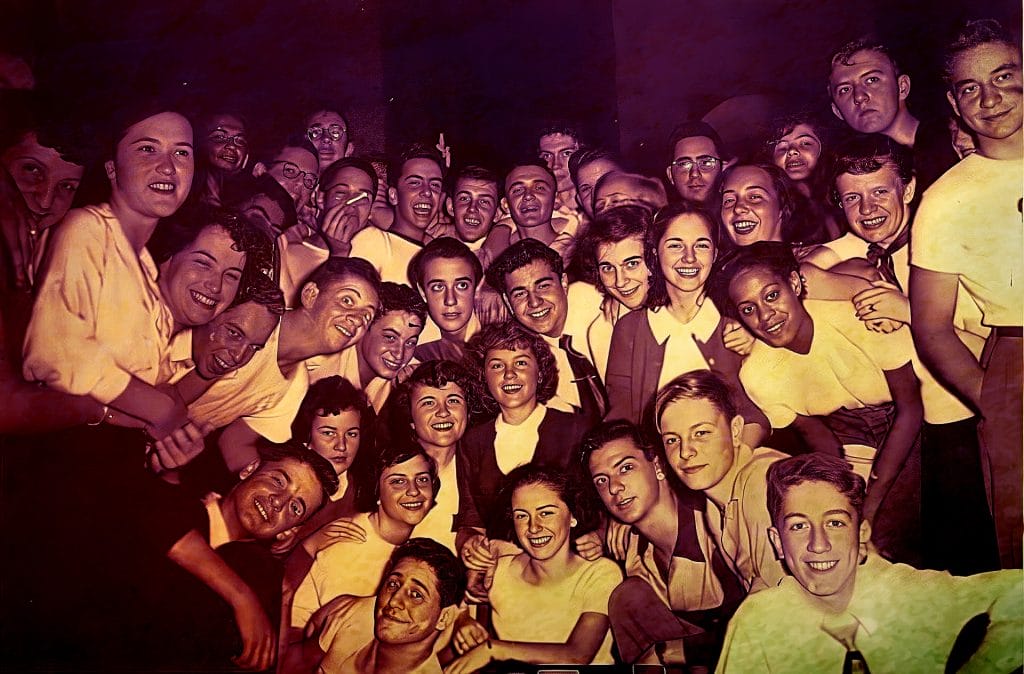
In 1948, education in the United States became more than a local concern of school boards and parents; it emerged as a national issue tied directly to democracy, economic stability, and the growing ideological struggle between America and the Soviet Union. In the years immediately following World War II, Americans faced an alarming shortage of teachers, overcrowded classrooms, and aging school facilities, all while confronting the realization that the nation’s future strength depended heavily on how well it educated its young people. The subject was increasingly discussed on radio programs such as Northwestern Reviewing Stand, where educators, civic leaders, and commentators debated whether the United States was prepared to meet the educational challenges of the postwar era.
One of the most pressing problems in 1948 was the severe shortage of qualified teachers. During World War II many teachers had left the profession for military service or better-paying industrial jobs connected with wartime production. After the war, large numbers never returned to teaching because salaries remained comparatively low and working conditions were often difficult. At the same time, the beginning of the postwar “baby boom” caused school enrollment to rise sharply. Communities across the country suddenly found themselves responsible for educating millions more children than expected.
The result was overcrowded classrooms that strained the American educational system to its limits. In many cities, classes of forty or even fifty students became common. Some schools were forced to operate on double shifts, with one group of students attending in the morning and another in the afternoon. Temporary classrooms were created in church basements, converted army barracks, and other makeshift spaces. Rural schools, already suffering from limited resources before the war, often lacked modern textbooks, transportation, and adequate buildings. Americans increasingly worried that these conditions threatened the quality of education available to the next generation.
Beyond the practical concerns of overcrowding and staffing shortages, education in 1948 carried enormous symbolic importance. The Cold War was beginning to reshape American thinking, and many policymakers believed that schools represented a critical battleground in the competition between democracy and communism. The Soviet Union placed heavy emphasis on technical education, scientific training, and ideological discipline among young people. American observers feared that if the United States failed to improve its schools, it could eventually lose its leadership in science, industry, and world influence.
This fear was intensified by the growing realization that modern warfare and international power depended not only on military strength but also on intellectual achievement. The atomic bomb had demonstrated the importance of scientific knowledge, and many Americans believed that future global leadership would belong to whichever nation best educated its citizens. Educational achievement therefore became connected to national security. Teachers were no longer viewed merely as local instructors; they were increasingly seen as defenders of democracy itself.
Programs such as Northwestern Reviewing Stand reflected these anxieties by framing education as both a civic responsibility and a strategic necessity. Discussions often emphasized that democratic societies depended upon informed citizens capable of independent thought. Unlike totalitarian systems, which relied on propaganda and rigid control, the American system required citizens who could reason, debate, and participate intelligently in public life. Education therefore became central to preserving democratic values during a period of rising international tension.
At the same time, many reformers argued that the United States had neglected its educational system for too long. Teachers frequently earned salaries far below those of factory workers or office employees, discouraging talented young people from entering the profession. School construction lagged behind population growth, especially in rapidly expanding suburban areas. Critics warned that Americans could not expect world leadership while failing to invest adequately in public education.
The debate in 1948 also revealed broader questions about equality and opportunity. Many Americans believed that education was the foundation of social mobility and economic advancement. Returning veterans attending college under the G.I. Bill demonstrated how education could transform lives and strengthen the middle class. Yet educational opportunities remained uneven, particularly in poorer communities and in segregated school systems throughout the South. These inequalities raised concerns about whether America was truly fulfilling its democratic ideals.
In retrospect, the educational concerns of 1948 foreshadowed many of the major developments of the following decades. The teacher shortages, school construction programs, and emphasis on science and mathematics education would intensify during the Cold War, especially after the Soviet launch of Sputnik in 1957. Federal involvement in education gradually expanded as Americans recognized that schooling had become a matter of national importance rather than purely local responsibility.
The debates heard on Northwestern Reviewing Stand captured a moment when Americans understood that classrooms were connected directly to the future of the nation. In the uncertain years following World War II, education came to symbolize the strength of democracy itself. Faced with overcrowded schools, too few teachers, and growing rivalry with the Soviet Union, Americans increasingly believed that the education of young people was not simply preparation for adulthood — it was preparation for the survival and leadership of the United States in the modern world.
Here is that debate, as it aired on September 12, 1948 from the Northwestern Reviewing Stand program over the Mutual Broadcasting system.