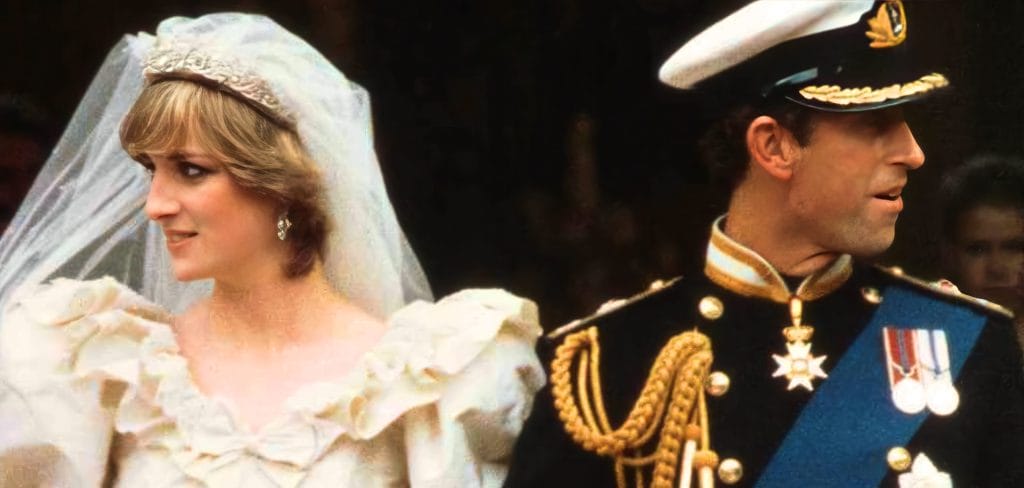
A Royal Wedding – The world watched – History waited.
A day of pomp and ceremony, this July 29th in 1981.
Hundreds of thousands of joyful Britons, taking a break from the strains of a difficult summer, lined the route of the royal wedding procession to cheer their crown prince and new princess. In a patriotic festival spirit, they wept and shouted and danced in the streets, waving Union Jacks and saluting the land with chorus after chorus of “Rule Britannia.” “It’s a great day to be British,” said Geoffrey Tirson, 72, a retired factory worker, his voice breaking as the Prince and Princess of Wales waved to the crowd from the second-floor balcony of Buckingham Palace. “I was right here standing on this very spot of grass on the night that Prince Charles was born,” he said. “That seems just like yesterday, and now here he is, married. I say, God bless him and her and all of us.” The traditional appearance on the balcony, which was draped with a gold-fringed scarlet banner, came moments after the couple and the rest of the royal family had returned from the ceremony at St. Paul’s Cathedral. Thousands of the viewers had slept on the sidewalks Tuesday night to make sure of getting a good vantage point.
“We want the queen,” they chanted after Charles and Diana had gone back inside, and in response the queen came out, to thunderous applause. Then, “We want the Queen Mum,” and out came Queen Elizabeth, the Queen Mother. Nearly everyone who was not out cheering seemed to be home watching the festivities on TV, and outside the center of London, streets generally were deserted. Along the route, the overnight scene was a carnival of silliness and fun, a street festival in which all the rules about reserve and not talking t to strangers seemed to have been repealed, and all sorts of people who might normally disdain one another punks, businessmen, little old ladies, skinheads, policemen – got along famously. A number of young people had painted their faces, or their hair, or their chests, red, white and blue, like the flag. Six Cambridge University students, in dinner jackets, set a formal table on The Mall and enjoyed an elegant candlelit dinner of poached salmon and champagne. Near dawn, with the temperature in the high 60s, scores of people splashed merrily in the fountains of Trafalgar Square. In fact, the revelry was at such a pitch that by the time of the wedding, scores of people, hung over and exhausted, inadvertently slept in the warm morning sunshine of St. James’s Park right through the spectacle that they had come to watch.
In the hotels and other buildings along the two-mile route, including many newspaper offices, law firms and financial institutions, there were dozens of stylish parties that began shortly after dawn and lasted into Wednesday evening. Pubs along the route stayed open late. As the opening bars of “God Save The Queen,” played by a band in the forecourt of Buckingham Palace, gave the signal that the procession of 11 horse-drawn carriages was beginning, thousands of cardboard periscopes were raised into position, thousands of cameras clicked in a frenzy and thousands of small children were thrust into the air for the historic view of so many royals on parade.
Although the new Princess of Wales became the third-ranking lady in Britain on this day with her marriage to Prince Charles, she can never ascend to the throne. The line of succession to the British throne at present passes from Queen Elizabeth to Prince Charles and then, if necessary, to his brothers Prince Andrew and Prince Edward and thereafter to his sister, Princess Anne. After that come Princess Anne’s children, Peter and Zara, the queen’s sister, Princess Margaret. If Charles and Diana have a son or a daughter, the succession will pass from Charles to him or her. If they have both, the first-born male child will have precedence.
In terms of rank, however, the Princess of Wales has become No. 3. Protocol requires that she curtsy only to Queen Elizabeth and the queen mother. Everyone else in the kingdom must curtsy to her.
Meanwhile, Police, prepared for a possible fourth consecutive night of violence in the troubled Toxteth district of Liverpool, ordered an Wednesday into the death of a man crushed by a police vehicle on the eve of the royal wedding. The fighting between police and black and white youths had escalated during each of the past three nights, lasting in its latest round until almost dawn Wednesday. Two hundred youths hurled gasoline bombs, bricks, stones and other objects at police in the fighting that began late Tuesday. The rioters set cars on fire to serve as barricades. Authorities said police were on standby alert Wednesday night.
And finally, Abolhassan Bani-Sadr, Iran’s fugitive expresident, escaped to France on Wednesday in an Iranian military plane, accompanied by the head of the nation’s leading leftist underground organization. The French government granted the 47-year-old BaniSadr political asylum. Several hours later, the Iranian government asked for his extradition. Disguised by shaving off his mustache, Bani-Sadr landed in an Iranian Air Force 707 jet at the Evreux After / being given political asylum, he was driven to the military air base 60 miles west of Paris at 4:30 a.m. apartment of a daughter in Paris suburb.
Pars, the official Iranian news agency, claimed that the plane was hijacked. Pars said fighter aircraft tried in vain to intercept the Iranian military Boeing 707 jetliner before it reached the frontier. Iran’s government spokesman, Behzad Nabavi, told Tehran Radio that Bani-Sadr probably was wearing a woman’s dress when he slipped aboard the Boeing 707. “What is clear is that he had plucked his eyebrows and shaved his mustache,” Nabavi said. Bani-Sadr told reporters outside his daughter’s apartment house that his flight was organized by the Mujahedeen Khalq, the Islamic Marxist guerrilla group that has become the only effective opposition to the fundamentalist Moslem clerics dominating Ayatollah Ruhollah Khomeini’s revolutionary regime.
Massoud Radjavi, leader of the Mujahedeen Khalq, accompanied Bani-Sadr and said the ex-president had been hiding in his home “in the heart of Tehran” since he went underground 43 days ago. “I was able to move about in the city thanks to the protection of the people and of those who support me,” Bani-Sadr added. Bani-Sadr said that he did not learn about the plans for him to leave Tehran until 6:00 Tuesday evening and that they left from a Tehran military base at 10:30 p.m. With him was Iranian Air Force Col. Behzad Moezi, who flew the plane and who Pars said was the personal pilot of the late Shah Mohammed Reza Pahlavi.
Moezi said the escape had been planned by BaniSadr’s sympathizers in the armed forces and by members of the former president’s entourage.
And that’s just a sample of what happened on this July 29th in 1981 as reported by The CBS World News Roundup.