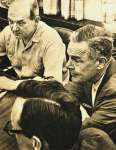
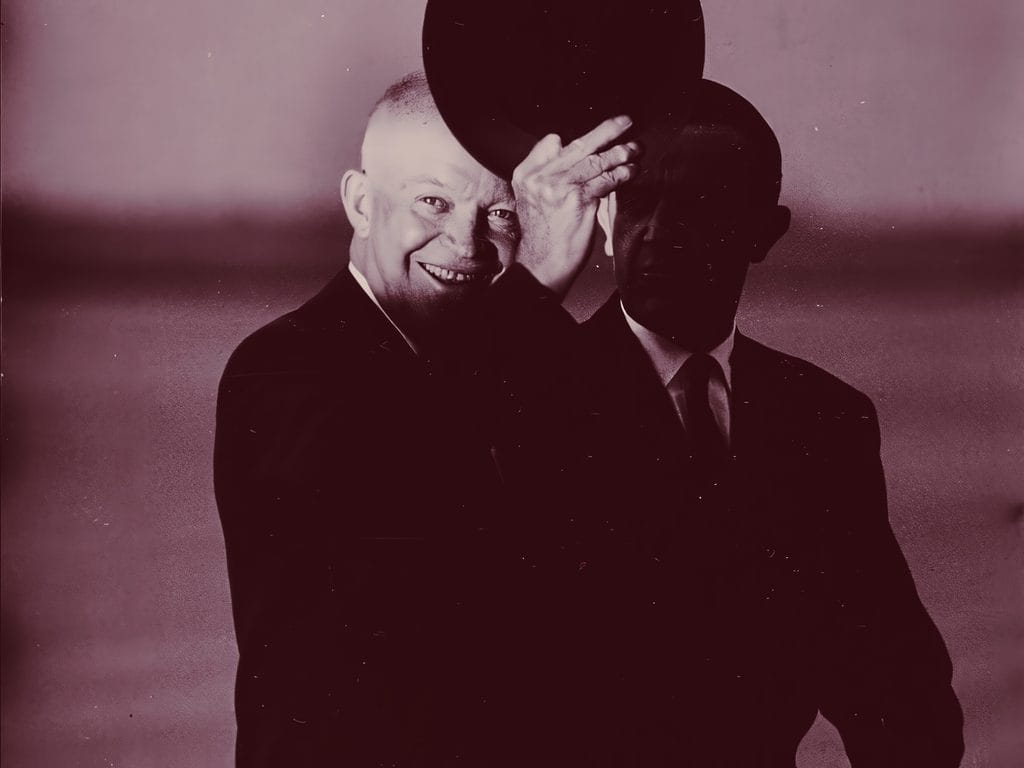
In May 1955, Dwight D. Eisenhower was approaching the midpoint of his first term in the White House, and the question confronting the country was no longer whether the former Supreme Allied Commander could win an election. He had already done that—twice, overwhelmingly. The more complicated question was what kind of president he intended to be. On May 22, 1955, NBC Radio’s American Forum put that question directly: “Is the President Meeting His Responsibilities?” The discussion brought together two members of the 84th Congress, Democratic Representative Emanuel Celler of New York and Republican Representative Hugh Scott of Pennsylvania. Their disagreement reflected a much larger argument about presidential power, responsibility and leadership.
Eisenhower presented an unusual figure in the modern presidency. He was a national hero, a five-star general and the man who had commanded the Allied forces in Europe during World War II. Yet as president he did not behave like Franklin Roosevelt or Harry Truman. He generally avoided dramatic public confrontation, frequently relied upon Cabinet officers and White House advisers, and preferred to exercise influence behind the scenes. To his critics, this could look like passivity. To his supporters, it looked like disciplined management.
That distinction lies at the heart of the American Forum discussion. The criticism that Eisenhower delegated too much authority was not simply a complaint about administrative procedure. It raised a constitutional question: how much of the president’s responsibility can be transferred to the people around him before the president himself ceases to be fully accountable?
Celler, a longtime Democrat and chairman of the powerful House Judiciary Committee, was naturally suspicious of an administration in which authority appeared to be distributed among advisers and Cabinet officials. The 84th Congress was itself a challenge to Eisenhower. Democrats had regained control of both chambers after the 1954 elections, meaning that Eisenhower had to govern with an opposition Congress. Celler’s criticism therefore had a partisan dimension, but it also reflected a genuine concern about executive responsibility: if the president possessed the authority, shouldn’t he personally exercise it?
Scott offered the Republican counterargument. As a Pennsylvania Republican, he was part of a party that had regained the White House but lost congressional control. Interestingly, Scott was not simply an unquestioning administration loyalist. Both he and Celler were members of the House Judiciary Committee, and Scott had participated in bipartisan congressional initiatives on issues ranging from civil rights to foreign affairs. Their exchange consequently represented a real political disagreement rather than a carefully scripted partisan exercise.
What makes the debate especially revealing in retrospect is that the criticism of Eisenhower’s delegation has not entirely disappeared from historical scholarship—but historians have subsequently complicated it. For many years Eisenhower was regarded as a passive president who allowed advisers to run the government. Later examination of his presidential papers produced a very different picture. Political scientist Fred Greenstein famously characterized Eisenhower’s method as “hidden-hand” leadership: the president often allowed others to appear to be making decisions while he quietly established the objectives, monitored the process and intervened when necessary.
In other words, Eisenhower’s apparent reluctance to “pull the reins” may have been, at least in part, a deliberate technique rather than evidence that he had dropped the reins altogether. His military experience had taught him the importance of delegation in managing an enormous organization. He understood that a president could not personally administer every department and every decision. But the historical evidence suggests that his delegation was often selective: he could give subordinates considerable authority while still retaining ultimate control over the direction of policy.
That does not necessarily make Celler’s criticism wrong. It makes the question more interesting. A president who governs quietly risks being mistaken for a president who does not govern at all. When decisions succeed, the system can look efficient; when they fail, responsibility becomes harder for the public to locate.
And that was ultimately the issue behind the 1955 debate. What does presidential responsibility actually mean? Does it mean personally directing every important decision, visibly taking command and accepting the political consequences? Or can leadership sometimes mean establishing objectives, choosing capable people, delegating authority and quietly making certain that the machinery moves in the desired direction?
Eisenhower believed the latter could work. His critics, including those represented by Celler in this broadcast, feared that it could weaken the presidency itself.
The irony is that history has largely vindicated parts of both arguments. Eisenhower was neither the disengaged figure his critics sometimes imagined nor the all-powerful strategist later historians occasionally portrayed. He was a president who deliberately cultivated an appearance of calm detachment while exercising considerably more influence than was immediately visible. The American Forum discussion captures something important about the political moment precisely because the participants did not yet have the benefit of hindsight. In 1955, the country was still trying to determine whether Eisenhower’s quiet style represented strength under control—or power being allowed to slip away.
And that question, as the broadcast demonstrates, was not merely about Dwight Eisenhower. It was about what Americans expected from their president in the modern age.
Here is that episode of American Forum from May 22, 1955.