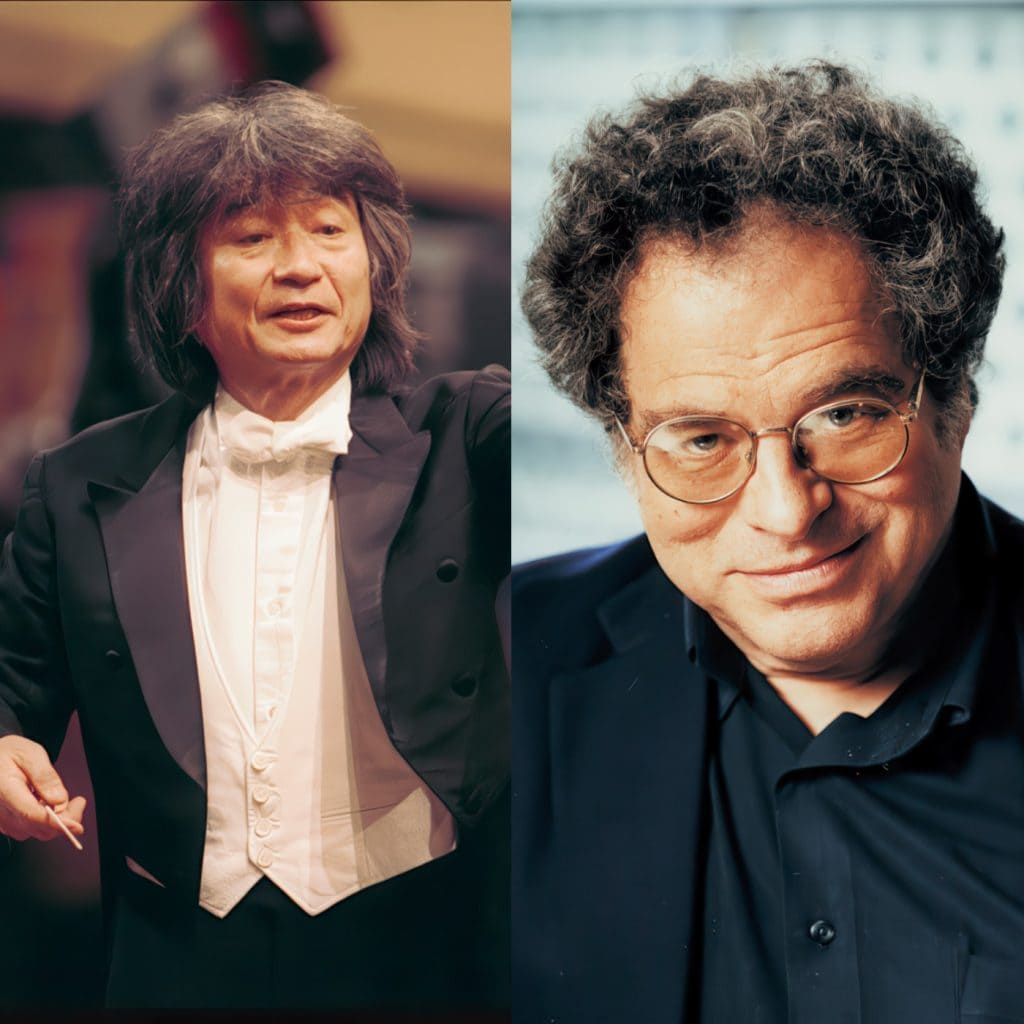
An abbreviated concert from the PBS series “Evening At Symphony” featuring the Boston Symphony led by Seiji Ozawa and featuring Itzhak Perlman, violin solo – recorded on February 2, 1978. Featured are two works: Stravinsky’s Violin Concerto (With Perlman as solo) and Brahms Symphony Number 3.
In 1970, Seiji Ozawa and Gunther Schuller became artistic directors of the Berkshire Music Festival in Tanglewood, the summer home of the Boston Symphony Orchestra (BSO). Ozawa became music director of the BSO in 1973. He remained in that position for 29 years, the longest tenure of any music director there, surpassing the 25 years held by Serge Koussevitzky. He conducted more world premieres, including works by Ligeti and Tōru Takemitsu.
Ozawa won his first Emmy Award in 1976, for the BSO’s PBS television series, Evening at Symphony; in 1994, he was awarded his second Emmy for Individual Achievement in Cultural Programming for Dvořák in Prague: A Celebration. He played a key role as a teacher and administrator at the Tanglewood Music Center, the Boston Symphony Orchestra’s summer music home that has programs for young professionals and high school students. In 1994, the BSO dedicated its new Tanglewood concert hall “Seiji Ozawa Hall” in honor of his 20th season with the orchestra. In recognition of his impact on the BSO, Ozawa was named music director laureate.
On 24 October, 1974, Ozawa conducted a Japanese combined orchestra which included the Toho Gakuen School of Music Orchestra and members of the Japan Philharmonic Orchestra with solo cello Tsuyoshi Tsutsumi and solo violist Nobuko Imai in a world-wide telecast (carried on the PBS television network in the United States) from the United Nations building in New York City. The concert included a work by Beethoven and Strauss’s Don Quixote with the two Japanese soloists.
In December 1979, Ozawa conducted a performance of Beethoven’s Ninth Symphony with the Beijing Symphony Orchestra. This was the first time since 1961 that the symphony was performed live in the People’s Republic of China due to a ban on Western music.
Ozawa gave notable performances of music of his countryman Toru Takemitsu, including “Orion and Pleiades” for cello and orchestra. In October 1990 he performed it with cellist Tsuyoshi Tsutsumi and the Boston Symphony Orchestra in honour of Takemitsu’s 60th birthday.
Ozawa made his debut with the Metropolitan Opera in New York City in 1992, conducting Tchaikovsky’s Eugene Onegin (opera), in a cast with Mirella Freni as Tatyana. He returned to the house in 2008 with The Queen of Spades, both productions described as passionate and electrifying.
Ozawa created a controversy in 1996–1997 with sudden demands for change at the Tanglewood Music Center, which made Gilbert Kalish and Leon Fleisher resign in protest. Subsequent criticism by Greg Sandow generated controversy in the press.
Ozawa used an unorthodox conducting wardrobe, wearing the traditional formal dress with a white turtleneck instead of the usual starched shirt, waistcoat, and white tie.
A major presence in the performing arts on television, Itzhak Perlman has been honored with four Emmy Awards, most recently for the PBS documentary Fiddling for the Future, a film about Mr. Perlman’s work as a teacher and conductor for the Perlman Music Program. In 2004, PBS aired a special entitled Perlman in Shanghai that chronicled a historic and unforgettable visit of the Perlman Music Program to China, featuring interaction between American and Chinese students and culminating in a concert at the Shanghai Grand Theater and a performance with one thousand young violinists, led by Mr. Perlman and broadcast throughout China. His third Emmy Award recognized his dedication to klezmer music, as profiled in the 1995 PBS television special In the Fiddler’s House, which was filmed in Poland and featured him performing with four of the world’s finest klezmer bands.
Mr. Perlman has entertained and enlightened millions of TV viewers of all ages on popular shows as diverse as The Late Show with David Letterman, Sesame Street, The Frugal Gourmet, The Tonight Show, and various Grammy Awards telecasts. His PBS appearances have included A Musical Toast and Mozart by the Masters, as well as numerous Live From Lincoln Center broadcasts such as The Juilliard School: Celebrating 100 Years. In 2008, he joined renowned chef Jacques Pépin on Artist’s Table to discuss the relationship between the culinary and musical arts, and lent his voice as the narrator of Visions of Israel for PBS’s acclaimed Visions series. Mr. Perlman hosted the 1994 U.S. broadcast of the Three Tenors, Encore! live from Dodger Stadium in Los Angeles. During the 78th Annual Academy Awards in 2006, he performed a live medley from the five film scores nominated in the category of Best Original Score for a worldwide audience in the hundreds of millions. One of Mr. Perlman’s proudest achievements is his collaboration with film composer John Williams in Steven Spielberg’s Academy Award-winning film Schindler’s List, in which he performed the violin solos. He can also be heard as the violin soloist on the soundtrack of Zhang Yimou’s film Hero (music by Tan Dun) and Rob Marshall’s Memoirs of a Geisha (music by John Williams).
Enjoy the concert – the tape is a bit creaky owing to age, but the spirit is all there.
It’s the spirit that counts.