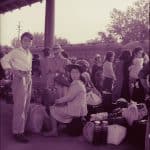
From Uganda this morning – President Idi Amin is out and President Yussufu Lule is in, but four midstate families who were forced to flee Uganda in 1972 have made no plans to return to Africa. “No, I won’t go back to Uganda to settle,” Rashmi Vasant of 19 Heidi Terrace, Camp Hill, said. “I settled again over here and this is home. I don’t think Uganda is completely safe yet, not until everything is settled and Amin is captured.” Shortly after being sworn in Friday in ceremonies in Kampala, Uganda’s capital, Lule called for the surrender of Amin and his followers. Amin, self presi- dent-for-life, began his military dictatorship in 1971.
Considered by many to be the world’s most brutal ruler, Amin has been accused of regarding Uganda’s resources and’ people as his private property, and directing the killing of between 150,000 and 300,000 Ugandan residents.
Meanwhile – An increase in iodine radiation levels reported over the weekend at the cripled Three Mile Island nuclear plant was probably caused by the release of gas from an air filtration system, a spokesman for the Nuclear Regulatory Commission (NRC) said Sunday. An air sample collected about 100 meters from the reactor at noon Saturday showed an iodine level of 119 picocuries per cubic meter. But those concentrations, which would have been considered dangerous away from the reactor site, had been dispersed by a factor of 15 before reaching nearby farmlands, said Karl Abraham, an NRC public information officer. A reading taken on the east side of the river across from the plant showed iodine levels equaling only readings of that level would subsequently show up in milk samples. Readings taken from air and grass samples are not directly comparable, Abraham said. The NRC has not set minimum safety standards for ground samples.
And who is getting the lion’s share of that 72 cents American motorists pay on the average for each gallon of gasoline? How much of it goes to the Organization of Petroleum Exporting Countries? What is the profit for the oil companies? And how much does the guy who is pumping the gas make from each gallon? Most oil companies and gasoline analysts are reluctant to hazard even vaguest of guesses about what percentage of the price of a gallon goes where. And those who will, point out that generalizing the percentages is difficult because taxes vary from state to state, dealer profit margins differ, and the cost of the crude oil used to make gasoline depends on whether the oil comes from a foreign or a domestic well. But a composite of several estimates of how gasoline costs break down goes something like this: The biggest chunk of the cost – the 72-cent figure is a basic average for all types of gasoline – goes to pay for the oil from which the gasoline is made. This portion is bigger for some companies than others because some, like Mobil and Exxon rely more heavily on foreign oil, which is more expensive than domestic petroleum. But on the average, about 45 percent, or more than 32 cents, of the cost of a gallon of gasoline is for the basic ingredient crude oil. The second largest component in the price of gasoline is federal, state and local excise taxes.
These vary from locality to locality and state to state, but in general, account for 20 percent, or more than 14 cents, of the cost of a gallon of gas.
And along with Uganda and neighboring countries, that’s just a little of what went on, this April 14, 1979 as reported by The CBS World News Roundup.