
March 27, 1980 – Walter Cronkite News and Commentary – CBS Hourly News – KNX Documentary – Gordon Skene Sound Collection –
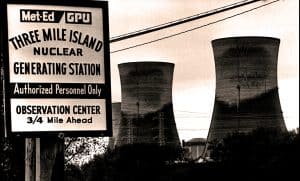
March 28, 1980 was an anniversary and we were reminded the day before that it was only a year since the disaster at Three Mile Island occurred. Only a year and we were still reeling from what was a veritable odyssey of “could’ve beens” – it wan’t the first for America, we had accidents going back to the 1950s, but nothing on this scale. Nuclear energy was the way of the future – we were told it was safe, nothing could happen. Disasters were the stuff of movies like The China Syndrome.
But there was nothing preventing what would be a catastrophic series of mistakes and miscalculations. Several state and federal government agencies mounted investigations into the crisis, the most prominent of which was the President’s Commission on the Accident at Three Mile Island, created by Jimmy Carter in April 1979.The commission consisted of a panel of twelve people, specifically chosen for their lack of strong pro- or anti-nuclear views, and headed by chairman John G. Kemeny, president of Dartmouth College. It was instructed to produce a final report within six months, and after public hearings, depositions, and document collection, released a completed study on October 31, 1979. The investigation strongly criticized Babcock & Wilcox, Met Ed, GPU, and the NRC for lapses in quality assurance and maintenance, inadequate operator training, lack of communication of important safety information, poor management, and complacency, but avoided drawing conclusions about the future of the nuclear industry. The heaviest criticism from the Kemeny Commission said that “… fundamental changes will be necessary in the organization, procedures, and practices—and above all—in the attitudes” of the NRC and the nuclear industry. Kemeny said that the actions taken by the operators were “inappropriate” but that the workers “were operating under procedures that they were required to follow, and our review and study of those indicates that the procedures were inadequate” and that the control room “was greatly inadequate for managing an accident”.
The 1979 TMI accident did not initiate the demise of the U.S. nuclear power industry, but it did halt its historic growth. Additionally, as a result of the earlier 1973 oil crisis and post-crisis analysis with conclusions of potential overcapacity in base load, forty planned nuclear power plants already had been canceled before the TMI accident. At the time of the TMI incident, 129 nuclear power plants had been approved, but of those, only 53 (which were not already operating) were completed. During the lengthy review process, complicated by the Chernobyl disaster seven years later, Federal requirements to correct safety issues and design deficiencies became more stringent, local opposition became more strident, construction times were significantly lengthened and costs skyrocketed. Until 2012, no U.S. nuclear power plant had been authorized to begin construction since the year before TMI.
Globally, the end of the increase in nuclear power plant construction came with the more catastrophic Chernobyl disaster in 1986.
But Chernobyl was in the future – a future that hadn’t happened yet in 1980. This day in 1980 we were still reeling and still cautious and still wondering if and when and Three Mile Island was going to happen again.
Starting with Walter Cronkite’s News and Commentary and then The World Tonight – here was what was going on, this day in 1980.
As you know, we’ve suspended indefinitely our ads in order to make Past Daily a better experience for you without all the distractions and pop-ups. Because of that, we’re relying more on your support through Patreon to keep us up and running every day. For as little as $5.00 a month you can make a huge difference as well as be able to download all of our posts for free (news, history, music). You’ll see a banner just below. Click on that and become a subscriber – it’s easy, painless and does a world of good.