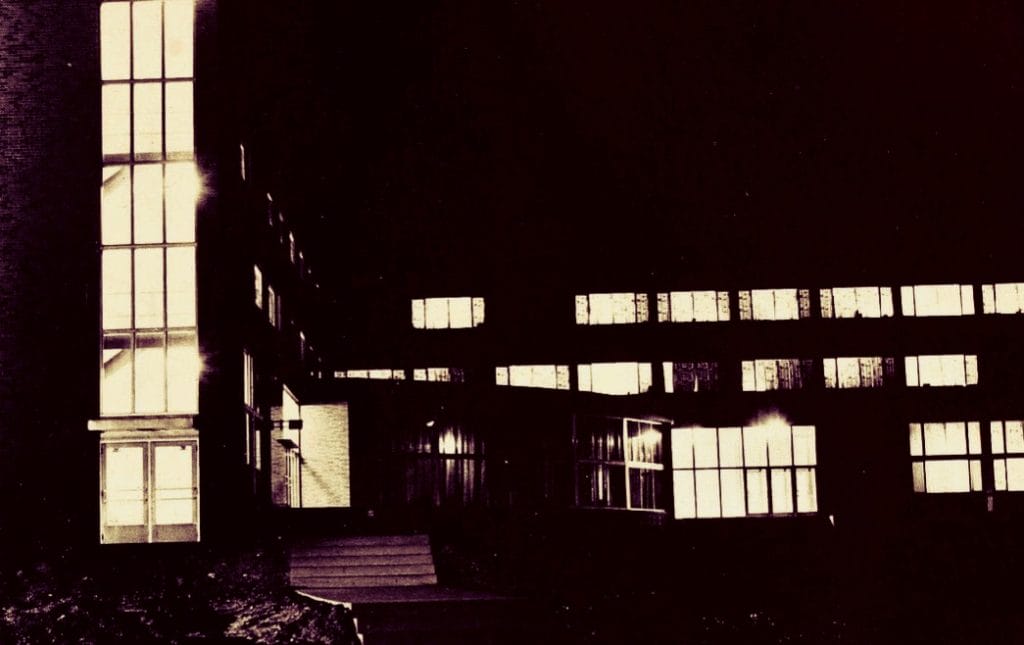
Working at night – More and more American workers, even White Color preferred the graveyard to the 9-5 in the 80s.
By the 1980s, the traditional American workday was beginning to look less traditional. The idea of working from nine to five remained deeply embedded in American life, but an increasingly large part of the economy operated around the clock. Hospitals could not close at five. Police and fire departments had to remain ready through the night. Factories ran multiple shifts, trucks moved freight while highways were relatively empty, and restaurants, convenience stores, hotels and other businesses increasingly catered to a society that expected services to be available whenever they were needed. The all-night worker had become an essential, if often overlooked, part of modern America.
A 1981 CBS Radio News documentary for the Newsmark series examined what it meant to work through the night, and its most interesting quality was that it did not portray night work as simply good or bad. There were advantages. There were also costs. And for many workers, the question was not whether they preferred working nights, but whether the night shift offered something they could not find during the day.
One obvious attraction was money. Night-shift workers in many industries received additional pay for working hours that most people preferred to spend asleep. For a worker trying to support a family, pay differentials could make an unpleasant schedule financially worthwhile. Night work could also provide a degree of independence. Some workers found the nighttime workplace quieter, less supervised and less crowded. A factory or office that was hectic during the day could become almost peaceful after midnight.
There were practical advantages as well. Parents could sometimes arrange shifts so that one parent worked during the day while the other worked at night, reducing the need for child care. Others appreciated being able to conduct personal business during normal daytime hours. Banks, government offices, doctors and stores were all easier to reach when a person’s working hours were reversed. For some people, particularly those who naturally considered themselves “night people,” the graveyard shift could even be preferable to getting up before dawn.
But the human body was not necessarily as adaptable as the workplace.
By 1981, researchers were paying increasing attention to the relationship between shift work, sleep, alertness and safety. A National Institute for Occupational Safety and Health presentation that year specifically examined sleep deprivation, circadian rhythms, work capacity, accidents and performance among shift workers. The research reflected a growing recognition that working at night meant fighting the body’s internal clock rather than simply changing one’s timetable.
Sleep was one of the central problems. A person finishing work at six or seven in the morning might theoretically have the entire day available for sleep, but daytime sleep was often interrupted by sunlight, traffic, telephones, household responsibilities and family members following a conventional schedule. The result could be a worker who was technically getting time in bed without getting the quality of sleep necessary for proper recovery.
The consequences extended beyond the workplace. Night workers lived in a world that was frequently out of step with everyone around them. Their children were awake when they were sleeping. Friends and relatives were working or socializing when they were preparing for work. Weekends could become complicated because the worker’s “weekend” might consist of sleeping through Saturday morning while everyone else was beginning the day. Marriage and family life could be affected simply because two people were awake at different times.
There was also the question of safety. Fatigue is not merely an inconvenience when a worker is operating machinery, driving a truck, monitoring patients or making decisions where mistakes can have serious consequences. The 1981 research community was already studying ways of improving alertness and designing shift schedules that reduced the dangers associated with fatigue.
What makes this 1981 CBS documentary particularly revealing is that it captures America at a moment when the twenty-four-hour economy was becoming increasingly normal. Night work was no longer confined to a handful of occupations. It was becoming part of the infrastructure of modern life.
The irony was that the people who made that twenty-four-hour society possible often paid a personal price for keeping it running. They enjoyed certain freedoms and financial advantages, but they also sacrificed something less easily measured: synchronization with the rest of society.
Working nights therefore represented more than an unusual work schedule. It was an early indication of a fundamental change in American life. The economy was learning to operate around the clock—and workers were being asked to adapt their lives and their bodies to it. Nearly forty years later, the questions raised by that 1981 broadcast remain remarkably familiar: How much should a job ask of us, and how much are we willing to give up in order to keep America running while everyone else is asleep?
As a reminder here is the CBS Radio Newsmark episode, Night Sounds from May 30, 1981.
And also as a reminder . . .