With all the news of upheavals, mass firings and general confusion prevailing this past week, the latest turn of events; the collision over the Potomac between an American Airlines jet and a Blackhawk Military helicopter which left no survivors, questions arose over the climate which stood the very strong possibility that such an accident could occur, recalled other times when Politics and Public Safety created an atmosphere where dire consequences threatened and in some cases became reality.
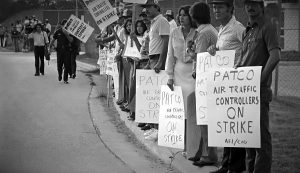
One such series of events took place in August of 1981 between the Air Traffic Controllers and the White House, where the Controllers Union threatened to strike if demande of a higher wage and more livable conditions were met and President Reagan, who felt government employees had no right to strike and that walking off the job and joining a picket line were tantamount to abandoning a signed oath to protect Public Safety.
The PATCO strike of 1981 was important to American labor relations, which illuminated the problems faced by air traffic controllers and the growing animosity between organized labor and the federal government. Stress at work and a desire for better working conditions, such as fewer hours, more money, and increased worker safety, were the main reasons controllers chose to go on strike. The controllers’ burnout became worse under the heavy workload brought on by increasing aviation traffic. Members of the Professional Air Traffic Controllers Organization (PATCO), many of them who were veterans of the armed forces with strong rebelliousness towards authority, had shown much of support for the organization. They thought that a strike would win political support and public sympathy since they were fed up with the Federal Aviation Administration’s (FAA) lack of respect for them. Their sense of support was incorrect, as President Ronald Reagan, who had received support from many controllers, responded aggressively. A big shift in labor politics occurred when Reagan ruled that the strike was unlawful and ordered the dismissal of more than 11,000 striking controllers.
As a reminder of that strike and of the fallout as a result – here are two nights broadcasts from the ABC News program Nightline beginning with the broadcast of August 4th when the mass firings were looming and the next day, the 5th of August, after the strike deadline passed and the mass firings were underway.